What Is Camera-Based Photoplethysmography? A Telehealth Engineering Primer
A telehealth engineering primer on camera-based photoplethysmography, from signal extraction and video constraints to real-world virtual care deployment.
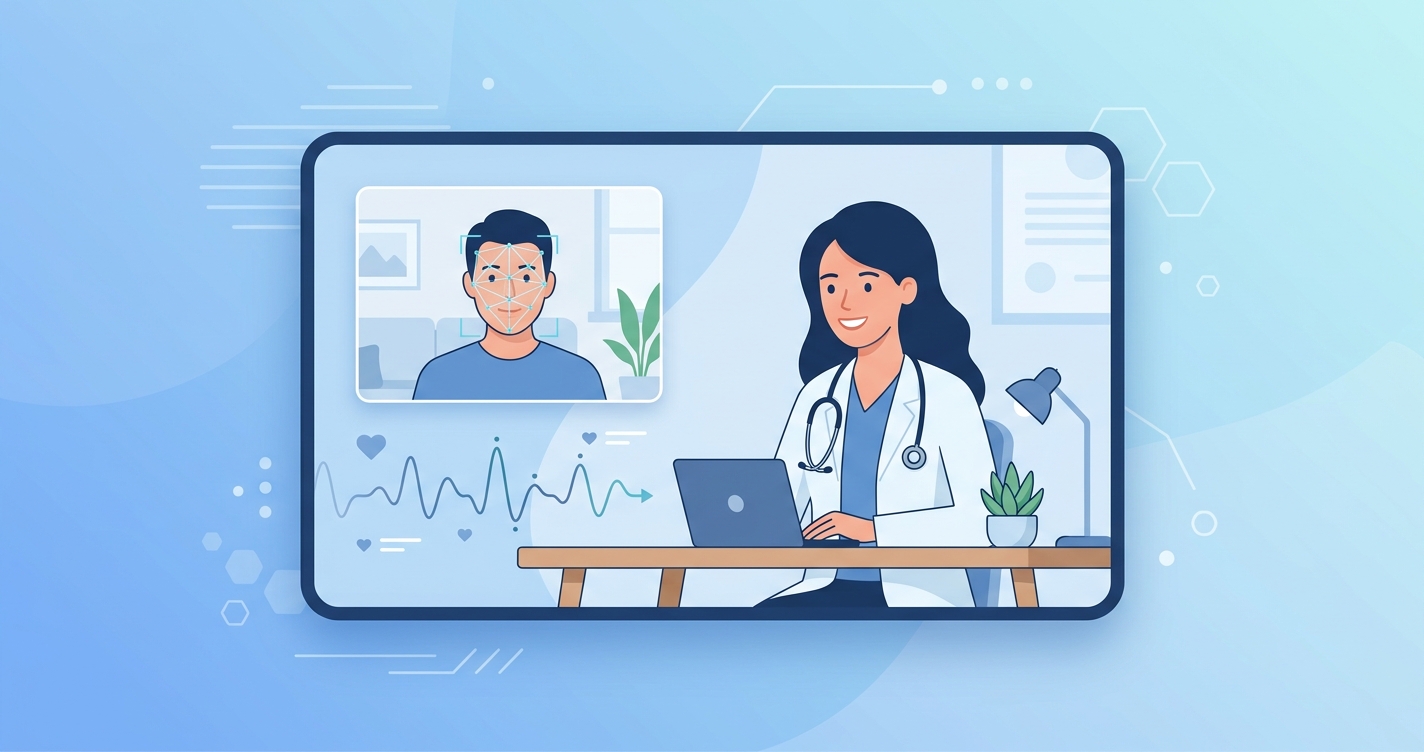
Camera-based photoplethysmography telehealth engineering primer is a long phrase, but the underlying idea is simple: use an ordinary camera to detect tiny color changes in the skin that track blood volume pulse, then turn that optical signal into usable physiologic data. For telehealth platforms, that is interesting for one reason above all others. The camera is already there. If a video visit already depends on a phone or laptop camera, then vital-sign capture becomes a software and signal-processing problem instead of a hardware distribution problem.
“Many existing rPPG methods struggled under challenging conditions, with five of eight showing a statistically significant decline in performance at elevated heart rates.” — Bhargav Acharya, William Saakyan, Barbara Hammer, and Hanna Drimalla, npj Digital Medicine (2025)
Camera-based photoplethysmography in telehealth starts with optical signal extraction
At the engineering level, camera-based photoplethysmography, often shortened to remote photoplethysmography or rPPG, works by analyzing frame-to-frame variations in reflected light from the face. Hemoglobin absorbs light differently across the cardiac cycle, so a standard RGB camera can capture a weak pulse-related signal when the pipeline is good enough.
Hanguang Xiao, Tianqi Liu, Yisha Sun, Yulin Li, Shiyi Zhao, and Alberto Avolio described this clearly in their 2024 review in Biomedical Signal Processing and Control: rPPG is attractive because it is noncontact, low cost, and well suited to remote monitoring, but it remains sensitive to motion, lighting variation, and video quality. That tension explains most of the engineering work. The hard part is not the concept. The hard part is making the signal survive real video visits.
A typical telehealth rPPG pipeline includes:
- face detection and region-of-interest selection
- frame-level color normalization across cheeks, forehead, or other facial regions
- pulse-signal extraction from RGB time series
- artifact suppression for motion, illumination shifts, and compression noise
- estimation models for heart rate, respiratory rate, oxygen saturation, or related metrics
- confidence scoring so the platform knows when not to trust the result
That last step matters more than teams sometimes admit. A telehealth stack does not just need a number. It needs a defensible way to distinguish usable captures from noisy ones.
| Engineering layer | What happens here | Why it matters in telehealth | Common failure mode | |---|---|---|---| | Video input | Camera frames arrive from phone or laptop | Determines baseline signal quality | Low frame rate, unstable exposure | | Face and ROI tracking | Facial regions are selected and followed over time | Keeps pulse extraction tied to stable skin areas | Head movement breaks tracking | | Signal processing | RGB fluctuations are converted into pulse-related traces | Extracts useful physiology from ordinary video | Lighting changes overwhelm the pulse signal | | Estimation model | Derived traces map to heart rate or other metrics | Produces visit-ready outputs | Model overfits lab conditions | | Quality control | Confidence, retry, and fallback logic are applied | Prevents bad readings from entering workflow | Platform displays weak estimates as facts |
Why telehealth engineers care about compression, motion, and lighting
If you are building for real video visits, the clinical story is only half the story. The other half is transport and rendering.
Telehealth video is rarely pristine. Frames may be compressed, bandwidth may dip, the patient may sit near a bright window, and the device may auto-adjust white balance mid-capture. Each of those conditions can weaken rPPG. Acharya and colleagues' 2025 CHILL dataset paper is a useful reminder that elevated heart rates remain a stubborn stress test. Low illumination hurt performance less than many engineers might expect, but higher heart rates exposed major weaknesses in several methods.
Compression is its own problem. Jieying Wang, Caifeng Shan, Zhaoyang Liu, Shuwang Zhou, and Minglei Shu reported in IEEE Journal of Biomedical and Health Informatics (2025) that conventional video compression can throw away physiologic information that rPPG needs. Their proposed compression approach preserved much more signal, even after videos were reduced to a small fraction of original size. For telehealth teams, that has a direct implication: media pipelines optimized only for visual appearance may not be optimized for physiology.
This is why engineering decisions upstream of the algorithm matter so much:
- camera resolution and frame-rate policy
- exposure and auto-gain behavior
- WebRTC settings and codec choices
- whether processing happens on-device, server-side, or in a hybrid path
- retry logic when face visibility or lighting quality drops
I keep coming back to this because it changes how teams scope the work. Camera-based vitals are not a widget you simply place inside the visit. They are a cross-stack feature touching frontend capture, transport, inference, quality monitoring, and clinical presentation.
Industry applications for camera-based photoplethysmography in telehealth
Video-visit intake and pre-visit capture
The cleanest use case is the one closest to existing workflow. A patient joins a video visit, completes a short capture sequence, and gives the clinician a quick set of objective signals before the conversation gets going. That can reduce dependence on verbal self-report alone.
Remote patient monitoring without extra hardware at the start
Some programs still need connected devices, especially for established blood pressure workflows. But for early screening or lightweight monitoring, camera-based capture lowers setup burden. That is one reason telehealth teams see it as an adoption tool, not just a measurement tool.
Triage and prioritization layers
Objective data inside the virtual encounter can support queue ranking and escalation logic. We looked at the workflow side of that in Telehealth Vitals and AI Triage: Automating Clinical Prioritization. The engineering prerequisite is stable signal capture under ordinary visit conditions.
SDK-based platform integration
For platform companies, the attraction is architectural. A software-based vitals layer can be embedded into existing apps, provider dashboards, or intake flows without mailing peripherals to every patient on day one. That is especially relevant for teams already evaluating WebRTC and rPPG: How Video Visit Infrastructure Enables Vitals.
Current research and evidence
Recent telehealth evidence is still early, but it is getting more concrete. Lynn A. Garvin and colleagues published a 2024 pilot usability study in JMIR Formative Research on the VA Video Connect platform. The study examined a contactless “Vitals” feature using smartphone-camera rPPG during telehealth visits. Providers and veteran patients rated it highly for usefulness, ease of use, acceptability, feasibility, and appropriateness. That does not settle the performance question, but it does show that clinicians and patients will actually engage with this workflow when it is embedded well.
The research base also keeps warning engineers not to confuse manual virtual workflows with strong physiologic data. Joshua P. Metlay, Ralph Gonzales, Timothy J. Judson, Yuchiao Chang, and colleagues reported in 2024 that patient-collected vital signs were highly specific for abnormalities but had weak sensitivity for some manual techniques, including only 25% sensitivity for elevated heart rate estimated by pulse and 60% sensitivity for elevated respiratory rate. In plain English: if telehealth depends on patients manually counting pulse or breaths, the input quality can be shaky.
Broader reviews reinforce the same point. The 2024 review by Xiao and colleagues framed rPPG as promising for contactless heart-rate monitoring but still constrained by dataset quality, motion artifacts, and deployment variability. A separate health-assessment review published in Frontiers in 2025 reached a similar conclusion: the technology is moving fast, but engineering robustness and validation still decide whether a telehealth implementation is credible.
I think that is the most honest way to read the field right now. The upside is real. So are the edge cases.
The future of camera-based photoplethysmography for telehealth platforms
The next phase probably belongs to boring engineering wins rather than flashy demos.
- better quality gating before a reading is shown
- codecs and capture settings chosen with physiologic signal preservation in mind
- more model testing on diverse lighting, motion, skin tone, and heart-rate conditions
- tighter integration with provider dashboards and documentation layers
- hybrid workflows that combine camera-based capture with device-based confirmation when needed
That is not a small agenda, but it is a practical one. Telehealth companies do not need a lab-perfect demo. They need a capture pipeline that behaves predictably on consumer hardware and fits inside clinical workflow.
For teams exploring adjacent build decisions, On-Device Processing vs Cloud: Vitals Architecture Tradeoffs and How to Add Vital Signs to Your Telehealth Platform are natural next reads.
Frequently Asked Questions
What is camera-based photoplethysmography?
It is a technique that uses a standard camera to detect subtle skin-color changes linked to blood volume pulse. Software analyzes those changes to estimate physiologic signals without attaching sensors to the body.
Why does camera-based photoplethysmography matter in telehealth?
Because telehealth already uses cameras. That creates a path to collect objective signals inside the virtual encounter without shipping extra hardware for every workflow.
What are the biggest engineering challenges with rPPG in video visits?
Motion, lighting variation, compression, device differences, and quality control are the biggest issues. A model that works in a controlled demo can still struggle in a live consumer video environment.
Can camera-based photoplethysmography replace all traditional devices?
Not in every workflow. The more realistic near-term role is adding low-friction physiologic capture to telehealth software, then pairing it with stronger review, triage, and escalation workflows.
Telehealth platforms are starting to treat camera-based vitals as infrastructure rather than novelty. Circadify is working in that direction with contactless vitals capabilities for SDK and custom telehealth builds. If you are evaluating how this fits into your own platform stack, see Circadify custom builds.