Telehealth Vitals and AI Triage: Automating Clinical Prioritization
Telehealth vitals AI triage prioritization is reshaping virtual care by adding objective signals to remote intake, escalation, and clinical routing decisions.
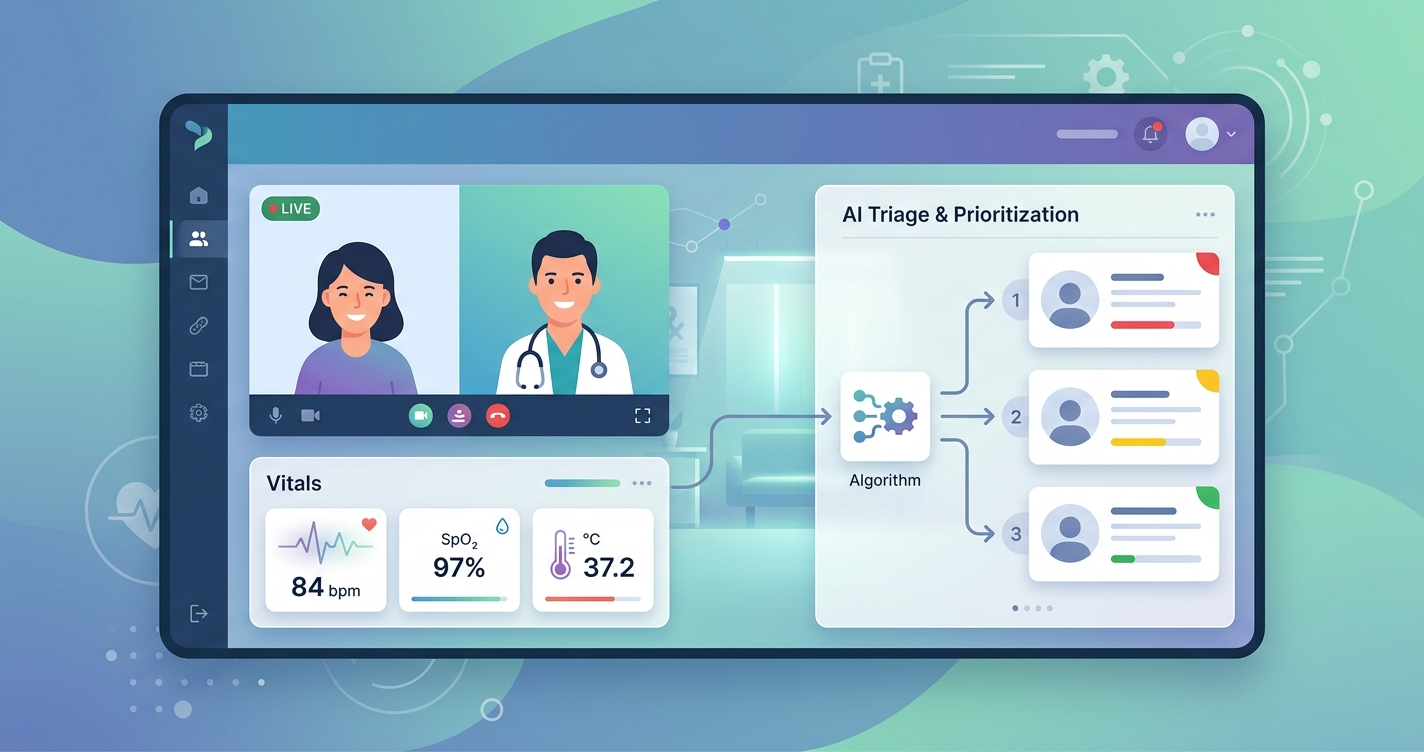
Telehealth vitals AI triage prioritization is starting to change a basic weakness in virtual care: most remote intake flows still depend too heavily on symptoms, self-report, and staffing queues that were built for administrative efficiency rather than clinical urgency. When heart rate, respiratory rate, oxygen saturation, and related signals can be captured during the digital encounter itself, triage logic stops guessing quite so much.
"Across all five conditions a weighted mean of 38.5% of individuals whose virtual triage indicated a condition requiring emergency care had no pre-triage intent to consult a physician." — George A. Gellert and colleagues, Frontiers in Public Health (2024)
Why telehealth vitals AI triage prioritization matters
The operational problem is straightforward. Most telehealth platforms can sort patients by appointment time, reported complaint, payer rules, or staffing availability. Far fewer can sort by probable physiologic risk in real time. That gap matters because the patient who says "mild shortness of breath" may look routine in a text intake flow while their oxygen saturation or respiratory pattern suggests something more urgent.
A 2024 paper by George A. Gellert, Aleksandra Kabat-Karabon, Gabriel L. Gellert, and Joanna Rasławska-Socha examined more than 3 million virtual triage interviews. Among patients whose symptoms pointed to one of five potentially life-threatening conditions, 33.5% had no intent to seek professional care even after adjustment for safety over-triage, and 53.5% had no intent to seek emergency care. That is the core argument for automation with better inputs: patient intent and patient acuity are often not the same thing.
Remote vitals help narrow that gap. They do not replace clinical judgment, but they give triage models something firmer than a checkbox list.
| Triage input | What it tells the platform | Main weakness | What happens when vitals are added | |---|---|---|---| | Symptom questionnaire | Reported complaint and timing | Subjective, inconsistent wording | Objective signals help validate urgency | | Scheduling metadata | Wait time and provider availability | Operational, not clinical | Routing can reflect risk, not just calendars | | Manual nurse review | Strong clinical context | Expensive and hard to scale | Automation can reserve staff time for edge cases | | Patient-owned devices | Useful when available | Many patients do not have them ready | Camera-based or built-in capture reduces setup friction | | Contactless visit-time vitals | Heart rate, respiratory rate, SpO2 trends, stress indicators | Depends on signal quality and workflow design | Creates a more clinically informed intake path |
What objective vitals add to remote prioritization
Triage models become more useful when they can recognize mismatch.
- A patient describes fatigue as routine, but resting heart rate is elevated above baseline.
- A cough is framed as mild, but oxygen saturation trends lower than expected.
- A follow-up visit looks administratively low priority, but respiratory rate and stress markers suggest deterioration.
- A queue is full of similar complaints, yet one visit shows the clearest need for immediate escalation.
That is where AI prioritization earns its keep. It can continuously rank encounters, flag outliers, and decide which cases deserve faster human review.
Ashika Farzana, Satish Kalepalli, Grant DeLong, Vishal Mehra, and colleagues reported in the 2024 AMIA Symposium that combining remote patient monitoring data with EHR data improved prediction of emergency department visits or unplanned inpatient admissions within 30 days, using data from 913 patients. Their feature set included at-home body weight, blood pressure, and blood oxygen. The lesson for telehealth product teams is broader than RPM alone: once physiologic signals enter the model, risk prediction improves.
For virtual care companies, the practical question is not whether AI can sort queues. It already can. The better question is whether the model is sorting on clinically meaningful data or just on operational proxies.
Industry applications for AI-assisted clinical prioritization
Urgent virtual care
Urgent care telehealth has the clearest use case. Patients arrive with uncertain severity, and the platform needs to decide who can stay virtual, who needs rapid clinician review, and who should be routed to emergency care. A triage system that sees symptom descriptions plus live vitals can make those distinctions earlier.
Chronic disease programs
Prioritization is not only about emergencies. In longitudinal care programs, AI can watch for gradual drift. A rising resting heart rate, lower oxygen saturation, or reduced autonomic stability across repeated visits can move a patient higher in the queue before they explicitly report worsening symptoms.
Hospital-at-home and post-discharge monitoring
These programs create a constant ranking problem: which patients need outreach first today? Vital-sign-informed scoring helps teams focus on the subset most likely to require intervention instead of reviewing every chart with the same urgency.
Behavioral health and integrated care
Not every case is cardiopulmonary, but physiology still matters. Elevated heart rate, respiratory changes, and stress-related markers can help clinicians understand whether a patient in distress needs immediate clinical attention, medication review, or a different follow-up path.
For telehealth engineering teams, related architecture questions show up in posts like WebRTC and rPPG: How Video Visit Infrastructure Enables Vitals and Why Telehealth Platforms Need Built-In Vitals Capture.
Current research and evidence
The evidence base is converging from several directions.
First, virtual triage research suggests that many patients underestimate the seriousness of their symptoms. Gellert's 2024 Frontiers in Public Health study is one of the clearest demonstrations of this disconnect at scale.
Second, emergency-care telemedicine research suggests that remote triage performs best when it improves throughput and diagnostic alignment in lower-acuity and mixed-acuity settings. In a 2024 systematic review in Cureus, Anas A. Ahmed, Mohammed E. Mojiri, Ali A. Daghriri, Ohoud A. Hakami, and coauthors found that telemedicine in emergency department settings improved diagnostic accuracy, reduced re-consultation rates, and often shortened throughput times, especially in non-critical cases.
Third, the literature also shows why better vital-sign capture matters. Joshua P. Metlay, Ralph Gonzales, Timothy J. Judson, Yuchiao Chang, and colleagues reported in Telemedicine and e-Health (2024) that patient-collected vital signs were not uniformly accurate. Sensitivity was especially weak for manually estimated elevated heart rate at 25% and elevated respiratory rate at 60%, while pulse oximeter heart rate, oxygen saturation, and oral temperature performed better. In other words, telehealth workflows that rely on patients to manually count pulse or breathing rate are building on shaky inputs.
That weakness is one reason contactless measurement has drawn attention. A 2024 review by Ali S. Salim and Abdul Sattar M. Khidhir at the University of Sulaimani found that modern remote photoplethysmography methods can extract heart rate from standard RGB video with low error under controlled conditions. For telehealth platforms, that matters less as a novelty and more as a workflow advantage: the video visit already exists, so the signal source is already present.
Where automation helps most
The strongest near-term use cases are not fully autonomous diagnosis. They are narrower, and honestly more useful.
- Ranking inbound telehealth visits by probable physiologic urgency
- Triggering faster clinician review when symptom severity and vital signs diverge
- Escalating patients from asynchronous intake to synchronous video or nurse review
- Prioritizing outreach lists in chronic-care and post-discharge programs
- Supporting documentation and audit trails for why a case was escalated or deferred
That last point gets overlooked. Health systems usually want explainable routing logic. A queue score tied to symptom clusters plus vital signs is easier to defend than a black-box priority label with no visible clinical basis.
The future of telehealth vitals AI triage prioritization
The long-term direction seems fairly clear. Telehealth platforms are moving from communication tools toward clinical operating systems. Once that happens, prioritization cannot stay purely administrative.
The next phase will likely combine three layers:
- passive signal capture during the visit
- AI models that rank or re-rank cases continuously
- workflow controls that route patients, alert staff, and document decisions inside the care stack
This does not mean every virtual visit becomes an emergency-screening event. It means virtual care gains the same thing in-person care has always had: a faster way to tell who needs attention first.
Companies such as Circadify are building toward that model by making it possible to add contactless vital signs capture to telehealth experiences without requiring patients to own extra hardware. For platform teams, that creates a practical path toward more clinically informed triage instead of another layer of intake forms.
Frequently asked questions
What is telehealth vitals AI triage prioritization?
It is the use of remote vital-sign data plus AI-based risk scoring to rank, route, or escalate telehealth encounters based on likely clinical urgency rather than only scheduling rules or symptom text.
Why are vitals important in virtual triage?
Symptoms alone are subjective. Objective measures such as heart rate, respiratory rate, and oxygen saturation can reveal risk that the patient either underreports or does not recognize.
Can AI triage replace nurses or physicians?
No. The realistic role is prioritization and escalation support. AI helps surface the right cases faster, while licensed clinicians still make diagnostic and treatment decisions.
Why not just ask patients to collect their own vital signs?
Home measurements can be useful, but the evidence shows they are not uniformly accurate, especially when manual techniques are involved. Built-in or contactless capture can reduce variability and improve workflow consistency.