White-Label Contactless Vitals for Telehealth Vendors
Learn how telehealth platforms are integrating white-label contactless vitals using rPPG SDKs to launch branded remote monitoring features without the R&D cost.
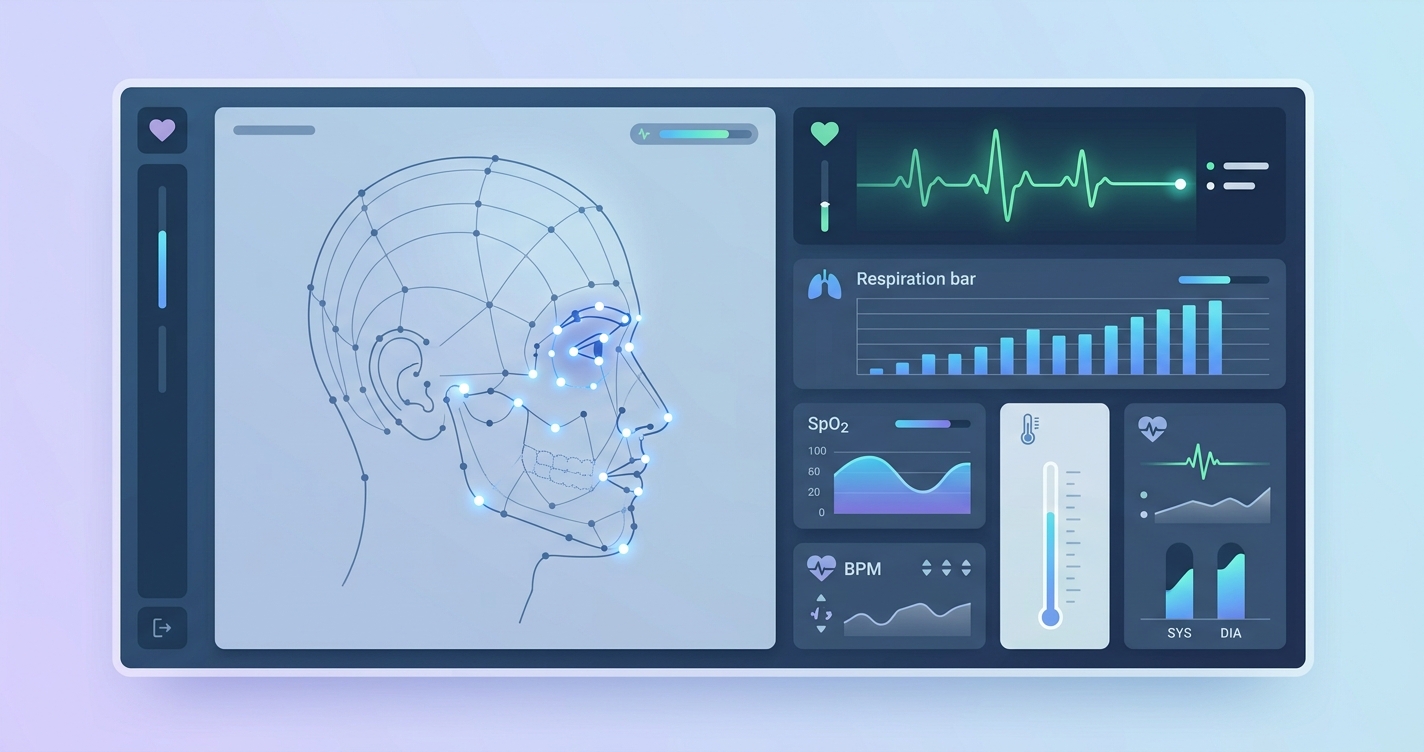
The transition from simple video connections to comprehensive virtual clinics has forced software vendors to evaluate how they capture clinical data. Standard telehealth platforms solve the geographic access problem but often leave providers with zero objective physiological data during the call. To bridge this gap, engineering teams are seeking ways to integrate camera-based measurements directly into their existing interfaces. Instead of building complex computer vision algorithms from scratch, platforms are using white-label telehealth vitals. This approach allows product managers to embed remote photoplethysmography (rPPG) technology seamlessly, delivering clinical value to end users while keeping the underlying complexity entirely hidden behind the vendor brand.
"Integration solutions within the broader telehealth market were valued at an estimated USD 18 billion to 25 billion in 2024 as platforms transition from simple video connections to comprehensive virtual clinics." (Healthcare Plus24 Industry Report, 2024)
The strategic shift to white-label telehealth vitals
For Chief Technology Officers and Vice Presidents of Engineering at telemedicine software vendors, adding a vital signs feature is a classic build versus buy decision. Building an rPPG engine in-house requires specialized knowledge in optical physics, computer vision, and machine learning. Furthermore, it demands massive datasets to ensure the algorithms work across different skin tones, lighting conditions, and camera hardware. The timeline for such a project easily stretches into years.
Procuring a white-label vitals SDK changes the math entirely. A white-label integration allows platforms to license an existing, tested rPPG engine and embed it into their own code base. The end patient and the healthcare provider never see a third-party logo. The entire workflow, from the moment the camera activates to the display of the final heart rate or respiratory rate, happens within the familiar environment of the host application. This model significantly accelerates time to market while drastically reducing research and development costs.
| Metric | Building In-House | White-Label Vitals SDK | | :--- | :--- | :--- | | Development Time | 18 to 36 months | 2 to 6 weeks | | R&D Investment | High (requires specialized AI engineers) | Low (standard SDK licensing fee) | | Clinical Validation | Must be conducted independently | Inherited from technology provider | | Maintenance Burden | High (constant algorithm updates required) | Low (handled by the SDK provider) | | Brand Control | Complete | Complete (fully customizable UI/UX) |
Core advantages of branded vitals capture
Adopting an embedded vital signs architecture provides several distinct advantages for telehealth platforms looking to scale their offerings quickly and reliably.
Seamless workflow integration
The most significant barrier to any new clinical tool is friction in the provider workflow. If doctors have to open a separate tab, log into a different application, or instruct a patient to download a secondary app, adoption rates plummet. A white-label vitals SDK lives within the main video consultation window. When the provider wants to check a pulse, they simply click a button in the platform they are already using. The SDK handles the camera stream processing locally on the patient device and passes the final computed metrics back to the host application via secure data flows.
Maintaining brand consistency
Patient trust is closely tied to the software experience. When users are bounced between different branded portals, they can become confused or suspicious about where their data is going. White-labeling ensures that the vital signs capture process looks and feels like a native feature. Development teams can apply custom cascading style sheets, customize the loading screens, and define exactly how the physiological data is visualized on both the patient and provider sides.
Telehealth platform differentiation
The telehealth software market is increasingly crowded. Basic high-definition video and secure messaging are no longer enough to win enterprise contracts with major hospital systems. Platforms need advanced clinical capabilities to stand out. Offering contactless vitals telemedicine gives sales teams a highly demonstrable, recent feature. It proves to clinical buyers that the platform is designed for real medical assessment, not just conversational check-ins.
- Speeds up the enterprise sales cycle by offering distinct clinical capabilities.
- Allows platforms to target higher acuity care models like chronic disease management.
- Provides a pathway to support remote patient monitoring billing codes.
- Keeps engineering teams focused on core application logic rather than sensor physics.
Overcoming common integration challenges
While a white-label vitals SDK eliminates the need to build core computer vision algorithms, engineering teams still face practical challenges during deployment. Successfully rolling out branded vitals capture requires careful attention to the end-user environment.
Managing variable patient environments
The most significant variable in any video visit is the patient's physical environment. Unlike a controlled clinical setting, a patient might be sitting in a dimly lit living room or directly in front of a bright window. Telehealth software vendors must build robust user interfaces that guide the patient into optimal conditions. This might include on-screen prompts asking the user to face a light source or notifications if the background is too bright. The best implementations use real-time feedback loops from the SDK to trigger these UI elements automatically, ensuring high-quality data capture without frustrating the patient.
Optimizing for low bandwidth connections
Telemedicine must serve patients in rural or underserved areas where internet connectivity is inconsistent. Streaming high-definition video while simultaneously running complex rPPG algorithms can tax older devices. A well-designed white-label vitals SDK will process the video feed locally on the edge device, extracting the vital signs data before the video is compressed and sent over the network. This edge computing approach means that even if the video stream drops in quality during transmission, the vital signs metrics remain highly accurate because they were calculated at the source.
Ensuring data security
For technology leaders, security is always the top priority when introducing third-party dependencies. Because the physiological calculation happens locally, modern SDKs do not require transmitting raw video frames to external servers. Only the final numerical output is passed through the secure application programming interface. Vendors can encrypt this data payload using their existing security protocols, ensuring full compliance with global data protection regulations.
Current research and evidence
The underlying technology powering these SDKs has been rigorously tested in both academic and clinical settings. Remote photoplethysmography relies on extracting the minute pulse signal from video frames, a process that has seen immense accuracy improvements thanks to deep learning.
A 2022 hospital-based trial by researchers Allado et al., published in the National Institutes of Health repository, evaluated the clinical viability of these optical methods. The study confirmed that remote photoplethysmography is an accurate method to remotely measure respiratory rate, highlighting its direct applicability for teleconsultation environments.
Furthermore, optimizing the conditions for this technology has been a major focus for engineers. Research by Tohma et al. (2021) at the Tokyo University of Science investigated the optimal measurement conditions for telemedicine applications. Their work demonstrated that ensuring adequate lighting and sufficient camera frame rates (at least 30 frames per second) allows for precise heart rate variability measurements, guiding how software vendors should design their user prompts for the best results.
User acceptance is equally critical. In a 2024 pilot usability study conducted by researchers at the Veterans Affairs Boston Healthcare System, a contactless vital signs feature was deployed within the VA Video Connect platform. The usability test sessions revealed that both clinical providers and veteran patients found the technology highly useful and easy to use, scoring the system exceptionally well on standard usability metrics. This real-world deployment highlights the readiness of the technology for large-scale enterprise platforms.
The future of embedded vital signs
The capabilities of white-label vitals SDKs are expanding rapidly. Currently, most platforms focus on core metrics like heart rate, breathing rate, and sometimes estimated blood pressure. The next generation of these tools will use more sophisticated computer vision models to track even more nuanced physiological markers.
We are moving toward continuous, ambient tracking during video visits. Instead of requiring a patient to sit perfectly still for a thirty-second measurement window, future algorithms will passively filter out motion artifacts and lighting changes to provide a constant stream of vital sign data throughout a fifteen-minute consultation. This will allow providers to see how a patient's physiology reacts dynamically to questions or minor physical exertion.
Furthermore, machine learning models are becoming incredibly efficient at analyzing micro-expressions and subtle color shifts across highly diverse demographic groups. Historically, optical sensors have struggled with darker skin tones, a challenge known in the industry as the melanin penalty. The latest research and development efforts in the rPPG space are specifically targeting these disparities, training AI on massive, globally diverse datasets to ensure that embedded vital signs provide equitable clinical accuracy for every patient, regardless of their background.
Moreover, as edge computing becomes more powerful on mobile devices, all the video processing will happen instantaneously on the local hardware. This ensures maximum privacy, as no raw video data ever needs to be transmitted to the cloud, further simplifying security compliance for telehealth vendors while extending battery life for the end user.
Frequently asked questions
What is a white-label vitals SDK?
A white-label vitals SDK is a pre-built software package that allows developers to add contactless vital sign measurement to their own application. The technology provider supplies the core algorithm, while the telehealth platform controls the entire user interface and branding, making the feature appear native to their system.
How long does it take to integrate embedded vital signs?
For an experienced engineering team, integrating a modern SDK typically takes between two and six weeks. This timeline includes embedding the core libraries, designing the custom user interface, setting up the secure data pipelines to the provider dashboard, and conducting internal testing before release.
What parameters can an rPPG SDK measure?
Most clinical grade rPPG systems can accurately measure heart rate, respiratory rate, and heart rate variability. Some advanced models are also capable of estimating blood pressure and oxygen saturation, though these often require more rigorous lighting conditions and validation.
Do patients need special hardware to use this feature?
No. The primary advantage of this technology is that it operates using the standard cameras already built into smartphones, tablets, and laptop computers. There is no need to mail hardware to the patient or manage Bluetooth pairing issues.
Telehealth platforms can no longer afford to offer a clinical experience that lacks objective data. Circadify is actively addressing this space, providing the underlying technology that allows platforms to seamlessly capture physiological metrics through existing video feeds. If you are an engineering leader looking to enhance your platform without the immense cost of in-house development, you can explore the platform demo and SDK documentation at circadify.com/custom-builds to see how simple a white-label integration can be.