How Can I Get a Quick Health Check-Up From My Couch Every Week?
A weekly telehealth health check is shifting from device-dependent to contactless. How rPPG vitals during video visits drive patient adherence and engagement.
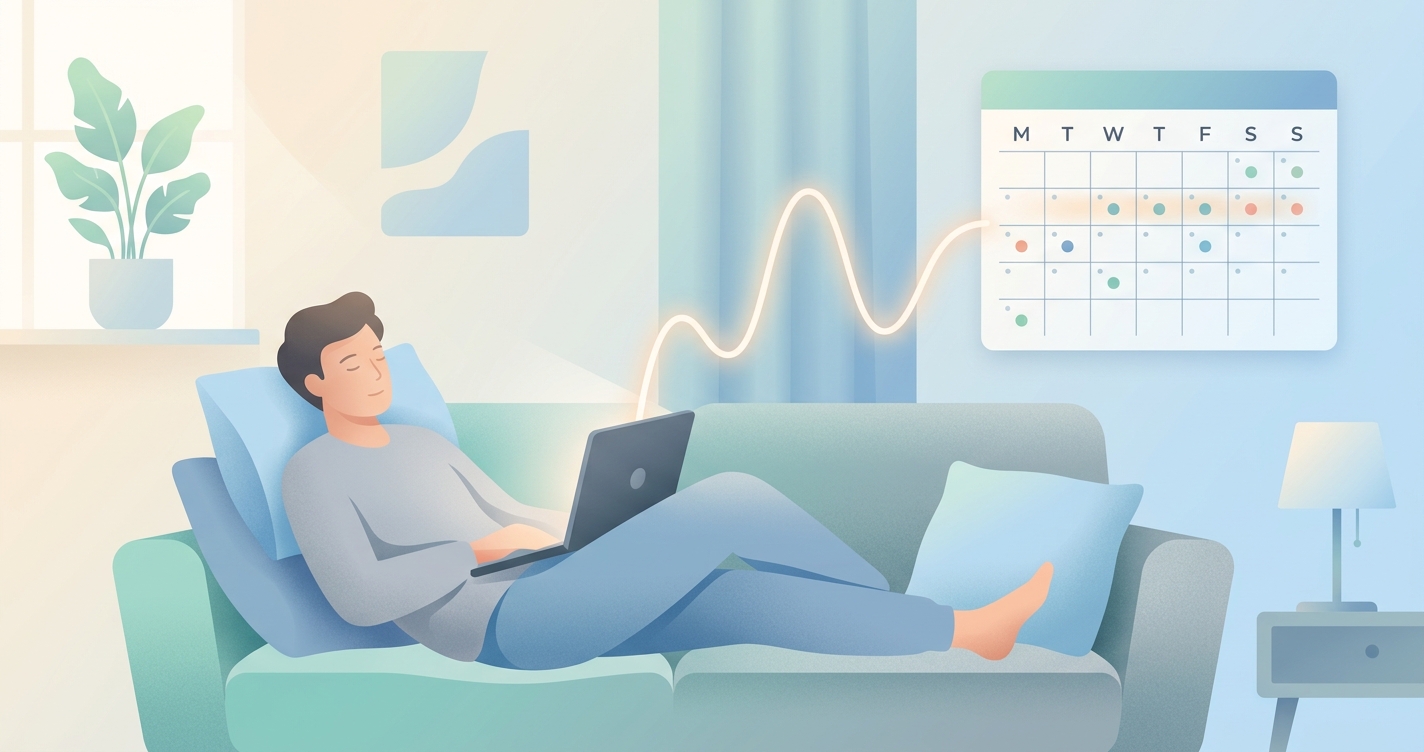
The consumer expectation for healthcare has quietly inverted. People who once tolerated an annual physical now want something closer to a routine, low-friction touchpoint with their care team, the kind of thing they can complete in the time it takes to watch a few minutes of television. A weekly telehealth health check, done from the couch with no cuffs to inflate, no finger clips to charge, and no Bluetooth pairing to troubleshoot, is the format most patients describe when asked what would actually keep them engaged. For telehealth platform companies, that preference is not a soft lifestyle trend. It is a direct signal about where retention, recurring engagement, and clinical value will come from over the next product cycle.
Remote patient monitoring is projected to reach 70.6 million U.S. patients by 2025, and 79% of healthcare providers believe RPM can improve outcomes and reduce hospital readmissions. Source: Grand View Research, 2024; Forbes Health, 2024.
Why the weekly telehealth health check depends on removing hardware
The friction in routine remote monitoring has never really been the video call. It has been everything wrapped around the measurement. When a weekly telehealth health check requires a patient to own, locate, charge, and correctly operate a separate device, adherence decays fast. Each piece of hardware adds a failure point, and every failure point becomes a reason to skip a week. The patients who most need consistent monitoring, older adults, people managing chronic conditions, lower-income households, are also the ones least likely to maintain a drawer full of working peripherals.
Contactless vital signs change the math. Remote photoplethysmography, or rPPG, extracts physiological signals from the subtle color changes in facial skin captured by an ordinary camera. No patient hardware is required beyond the phone or laptop they already use to join the visit. When vitals capture happens inside the video session itself, the measurement stops being a separate chore and becomes a byproduct of showing up. That is the difference between a feature patients endure and one they barely notice doing.
The strategic point for platform teams is that adherence is a product problem, not a willpower problem. The lower the action cost of a weekly check, the higher the completion rate. Contactless capture pushes that action cost close to zero.
Device-dependent vs contactless weekly monitoring
The contrast between the two models is clearest when you look at them side by side across the dimensions that actually drive patient behavior and platform economics.
| Dimension | Device-Dependent Monitoring | Contactless rPPG During Video Visit | | --- | --- | --- | | Patient setup | Buy, charge, pair, calibrate peripherals | None beyond existing camera | | Per-check friction | Locate and operate device each time | Happens passively during the call | | Onboarding cost to platform | Hardware logistics, shipping, support | Software SDK, no fulfillment | | Adherence risk | High dropout from device fatigue | Low, tied to showing up for the visit | | Equity of access | Limited by ability to buy devices | Available to anyone with a camera | | Data continuity | Gaps when device is lost or dead | Consistent week over week | | Recurring engagement hook | Weak, external to platform | Strong, native to the session |
A few patterns are worth pulling out of that comparison:
- The contactless model removes the single largest source of churn in routine remote monitoring: the device itself.
- Platform economics improve when hardware fulfillment and support tickets disappear from the cost structure.
- Data continuity is the quiet winner. Trend lines only have clinical value when they are unbroken, and contactless capture protects continuity.
- Access widens because the requirement collapses to a device patients already own.
Industry applications for platform companies
Chronic care programs
Chronic condition management lives or dies on consistency. Hypertension, heart failure, and post-discharge recovery programs all need regular vitals to detect drift before it becomes a crisis. A weekly telehealth health check that captures pulse rate, respiratory rate, and trend data without a device gives care teams a dependable signal cadence. For the platform, it turns episodic visits into a subscription-grade relationship with predictable engagement.
Preventive and wellness check-ins
Not every user has a diagnosis. A large segment simply wants reassurance and early warning. Offering a light, recurring check-in is a low-cost way to keep healthy users active on the platform between acute needs. These users rarely justify shipping them hardware, which is exactly why contactless capture unlocks the segment.
Employer and payer programs
Self-insured employers and payers fund engagement programs that demand measurable participation. A contactless weekly check produces clean adherence metrics without the procurement and distribution overhead of devices, making the program easier to sell and easier to scale across a covered population.
Post-acute and medication titration
Patients adjusting medication need frequent feedback loops. Capturing vitals during routine follow-ups lets clinicians see whether a change is working without asking the patient to self-report numbers they may record inconsistently.
Current research and evidence
The technical foundation for contactless weekly checks is more mature than many product leaders assume. A clinical validation study of rPPG-enabled contactless pulse rate monitoring in cardiovascular disease patients, published in PMC, reported strong agreement with ECG, a mean absolute error of 1.061 beats per minute and a Pearson correlation of 0.962. That level of agreement is meaningful for trend monitoring, which is the actual job of a weekly check.
Smartphone-based rPPG work has shown a relative mean absolute percentage error of 2.66% for heart rate, with systolic and diastolic blood pressure errors of roughly 6 to 7% in normotensive participants, according to research published on medRxiv evaluating an rPPG-enabled application. A 2024 systematic review of non-contact vision-based vital sign monitoring in MDPI confirmed that combining camera image processing with convolutional neural network methods materially improves the reliability of rPPG estimates.
The research is also honest about limits, which platform teams should respect rather than ignore:
- Accuracy can degrade at elevated heart rates, a constraint noted in work reported by News-Medical, so positioning matters: routine resting checks are the strong use case, not acute high-output scenarios.
- Skin tone, ambient light, and gaze direction influence signal quality, which makes guided capture UX a real engineering requirement.
- Pediatric performance varies by age, with one two-phased pediatric study finding strong heart rate correlation in children 12 to 16 but needing refinement for younger ages.
Set against patient demand, the evidence points the same direction. The remote patient monitoring market was valued at 53.6 billion dollars in 2023 and is projected to grow at a 19.7% compound annual rate through 2030, per Grand View Research. The behavioral driver, ease of use, is consistently cited as a top determinant of telehealth adherence.
The future of the weekly telehealth health check
The trajectory is toward checks that feel ambient rather than scheduled. As contactless capture matures, the weekly check stops being an event the patient initiates and becomes a continuous read taken whenever they happen to open the app or join a call. Several shifts are likely to define the next few years:
- Passive capture during any video interaction, not just clinical visits, so engagement data accrues without explicit measurement steps.
- Tighter coupling between contactless vitals and AI triage, so weekly trend data automatically flags which patients need a human follow-up.
- Reimbursement alignment, as remote monitoring billing pathways increasingly recognize software-captured vitals alongside device-captured ones.
- Personalization of cadence, where the platform adjusts check frequency based on individual risk rather than a fixed weekly default.
The platforms that win this period will treat the weekly check not as a standalone product but as the connective tissue that keeps patients returning. Contactless vitals are what make that cadence sustainable at population scale, because they remove the only component patients reliably abandon: the hardware.
Frequently asked questions
Can a weekly telehealth health check really work without any physical devices?
Yes, for routine resting measurements. rPPG extracts pulse and respiratory signals from a standard camera feed, and validation studies show strong agreement with reference instruments for heart rate. The strongest use case is consistent trend monitoring rather than acute high-output situations, where accuracy can degrade.
Why does removing devices matter for patient adherence?
Every device adds setup, charging, and troubleshooting steps, and each step is a reason patients skip a week. Research consistently identifies ease of use as a top driver of telehealth adherence. Capturing vitals during a video session the patient already joins removes nearly all of that friction.
What vitals can be captured contactlessly during a video visit?
Heart rate is the most established, with strong clinical agreement reported in cardiovascular patients. Respiratory rate and blood pressure trends are also achievable, with accuracy that improves when capture conditions, lighting, positioning, and stillness, are guided by the interface.
How does this benefit a telehealth platform commercially?
It converts episodic visits into recurring, measurable engagement without the cost of hardware fulfillment and support. That improves retention, produces clean adherence data for employer and payer programs, and widens access to anyone with a camera.
Circadify is addressing exactly this space, with an rPPG SDK that adds real-time, contactless vital signs to any telehealth platform during the video visit, no patient hardware required. Platform teams evaluating how to turn the weekly check into a durable engagement loop can explore the platform demo and SDK documentation at circadify.com/custom-builds.