Why Can't My Virtual Coach See My Fitness Progress During My Workout From My Tablet?
Why virtual coaching platforms still miss live workout data, and how telehealth vital signs via rPPG SDKs bring real-time heart rate to any tablet camera.
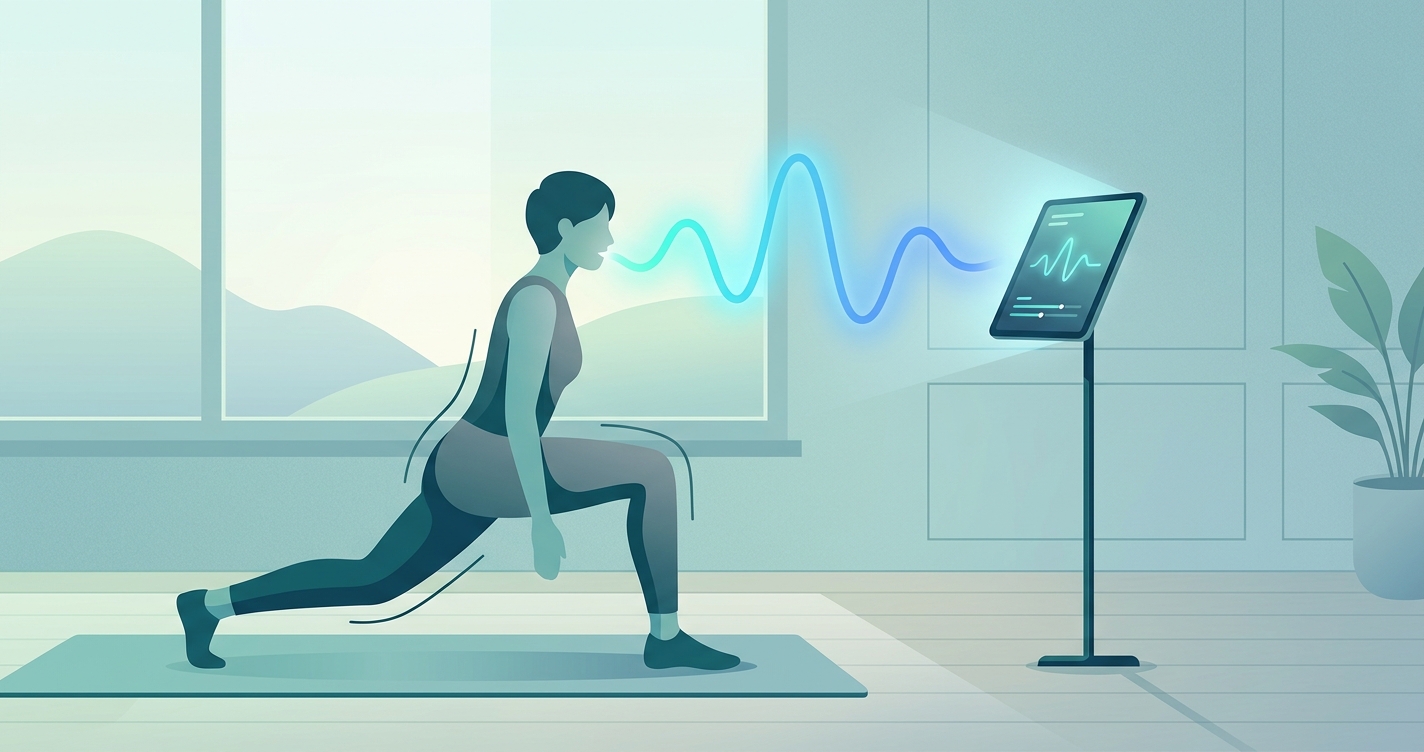
A client props a tablet against a water bottle, starts a guided session, and moves through the workout while the coach on the other end watches form and counts reps by eye. What the coach cannot see is the one thing that actually defines training load: what the body is doing on the inside. Heart rate, recovery between intervals, and breathing rate stay invisible, locked behind a wearable the client may or may not own and a data feed the coaching platform was never built to ingest. This gap is the central reason virtual coaching still feels like a downgrade from in-person training, and it is exactly the gap that telehealth vital signs technology has started to close. The same contactless measurement methods built for clinical video visits are now being evaluated for performance monitoring, and the platforms that integrate them first will define what remote coaching looks like for the next decade.
Remote photoplethysmography can extract heart rate, respiratory rate, and heart rate variability from a standard camera feed, and motion-compensated models reported in 2024 reached roughly 99 percent agreement with reference sensors during physical activity. Source: Enhanced Contactless Heart Rate Monitoring Using Camera with Motion Artifact Removal During Physical Activities, PubMed, 2024.
What telehealth vital signs actually bring to a coaching platform
The phrase telehealth vital signs usually conjures a doctor checking a patient's pulse over video. The underlying technology does not care whether the person on screen is a patient or an athlete. Remote photoplethysmography, or rPPG, reads tiny color changes in facial skin caused by blood flow with each heartbeat. From that signal an algorithm derives heart rate, respiratory rate, heart rate variability (HRV), and in some implementations estimates of blood pressure trend and oxygen saturation. None of it requires the client to wear, charge, or pair a device. The camera already pointed at them during the session is the sensor.
For a coaching product, that changes the economics of what the platform can promise. Instead of telling a coach to ask the client what their watch says, the platform can stream a live physiological readout into the same interface that already shows the video. The coach sees effort, not just movement. The client gets feedback that responds to their body rather than a generic timer.
The hard part has never been measuring a resting heart rate from a still face. It is measuring anything useful while the subject is actually exercising. Motion is the enemy of rPPG, and a workout is nothing but motion.
| Capability | Wearable chest strap or watch | Manual self-report on video | Camera-based telehealth vital signs (rPPG) | | --- | --- | --- | --- | | Client hardware required | Yes, owned and charged | None | None, uses tablet camera | | Live heart rate to coach | Only if data is shared | No, delayed and subjective | Yes, streamed in real time | | Respiratory rate and HRV | Limited or absent | No | Yes, derived from same signal | | Works during active movement | Strong, contact based | Not applicable | Improving, motion-compensated models | | Setup friction per session | Pairing, fit, battery | None | Camera permission once | | Platform integration effort | Per-device API, fragmented | None | Single SDK, one signal source |
Why movement breaks the camera, and what changed
The reason a virtual coach cannot currently see live fitness data is not that the camera lacks information. It is that the useful signal is buried under noise the moment the client starts moving. Head bobbing, changing lighting, sweat, and shifting distance from the lens all corrupt the faint color signal rPPG depends on. Early systems handled this by simply requiring stillness, which is fine for a clinical intake and useless for a burpee.
The research direction that matters for coaching is motion robustness. Several developments are worth noting for anyone scoping a build:
- Motion artifact removal models. A 2024 study published on PubMed described a camera-based pipeline using a Lion Optimization Algorithm-enhanced LSTM that reported roughly 99 percent accuracy in removing motion artifacts during physical activity, a meaningful jump over conventional computer vision approaches.
- Region selection. Work on body-location accuracy has found that the forehead tends to yield more reliable heart rate estimates during motion than peripheral sites, which informs where a coaching SDK should anchor its region of interest.
- Intensity-adaptive estimation. A treadmill-focused algorithm published in MDPI's Sensors switched between estimation methods as exercise intensity climbed, acknowledging that a single model cannot cover rest through maximal effort.
- Respiration during high effort. An MDPI evaluation of PPG-based respiration tracking during high-intensity interval training showed breathing rate can be recovered even under demanding conditions, which expands the metric set beyond heart rate alone.
The practical takeaway for a platform team is that "rPPG during exercise" is no longer a research fantasy, but it is also not a solved commodity. Accuracy is a function of model quality, lighting guidance, and how gracefully the system degrades when the signal drops.
Industry applications beyond the clinic
Personalized coaching platforms
A coaching platform that ingests telehealth vital signs can do something a rep counter never could: prescribe and adjust load in real time. If a client's heart rate is not climbing into the target zone, the coach knows the effort is too low before the session ends. If recovery between intervals stalls, that is visible too. The product shifts from delivering content to delivering physiology-aware coaching.
Corporate wellness and group fitness
Employers buying virtual wellness programs want engagement they can measure. A camera-based vitals layer lets a group class show aggregate effort, surface participants who should ease off, and report outcomes without shipping hardware to thousands of homes. The zero-device model is what makes population-scale deployment financially viable.
Telemedicine vendors expanding into performance
For telemedicine software vendors and CTOs, the coaching use case is an adjacent market reachable with the same SDK already justified for clinical visits. The signal pipeline that captures vitals during a video appointment is the same one that captures effort during a training session. Build once, address both buyers.
Current research and evidence
The evidence base for camera-based vitals has matured quickly. A 2024 comprehensive review of rPPG and deep learning, indexed in PMC, concluded that learning-based methods generally outperform classical signal-processing approaches for non-contact heart rate estimation, particularly under challenging conditions. Google Research has publicly described passive heart rate monitoring from smartphone cameras with an explicit goal of meeting accuracy standards across all skin tones in real-world settings, a reminder that fairness across phenotypes is a measurable engineering requirement, not an afterthought.
On the exercise side specifically, the motion-robust work cited above demonstrates that intensity detection and heart rate tracking are feasible during activity, while reviews informed by commercial rPPG deployments note that respiratory rate, HRV, and trend estimates for blood pressure and oxygen saturation are increasingly part of the standard output set. The consistent caveat across this literature is that performance during vigorous movement still trails performance at rest, and that validation should be specific to the conditions a platform actually operates in. A model validated on seated patients does not automatically transfer to a tablet on the gym floor.
The future of telehealth vital signs in coaching
The trajectory points toward vitals becoming a default layer of any video-based wellness or care product rather than a premium add-on. As motion-compensated models keep improving and on-device processing reduces latency and privacy exposure, the marginal cost of adding a physiological readout to a session approaches zero. The differentiator will not be whether a platform can show heart rate, but how it turns continuous signals into coaching decisions, how transparently it communicates confidence when the signal degrades, and how cleanly it routes that data into records and analytics. Expect the line between fitness platform and telehealth platform to blur, because the sensing stack underneath them is converging on the same camera.
Frequently asked questions
Can a tablet camera really measure heart rate while someone is exercising?
Yes, within limits. Motion-compensated rPPG models reported in 2024 reached high agreement with reference sensors during activity, but accuracy still depends on lighting, camera quality, and how much the client moves out of frame. A well-built system communicates confidence and degrades gracefully rather than reporting a wrong number.
What vital signs can a coaching platform capture without a wearable?
Heart rate is the most mature output, followed by respiratory rate and heart rate variability, all derived from the same facial blood-flow signal. Some implementations also estimate blood pressure trends and oxygen saturation, though these vary more in reliability and should be validated for the intended use.
How much engineering does it take to add this to an existing platform?
The practical path is an SDK that handles signal capture, region selection, and motion handling, exposing a clean data stream to your interface. That avoids the fragmented per-device integration of wearables and lets one signal source serve both clinical and coaching contexts.
Is camera-based vitals data subject to the same privacy rules as clinical data?
If the data identifies a person and relates to health, it generally falls under health privacy obligations regardless of whether the use is medical or fitness. On-device processing and clear consent flows are common ways platforms reduce exposure while keeping the feature useful.
Circadify is building toward this convergence directly, developing a contactless rPPG SDK that adds real-time vital signs to any video-based platform without asking the end user for hardware. Teams evaluating performance monitoring or personalized coaching features can review the platform demo and SDK documentation at circadify.com/custom-builds to see how the same signal pipeline serves both clinical visits and live workouts.