How Can My Doctor Tell If My Cold Is Getting Worse From My Phone Screen This Winter?
Video visit vital signs let clinicians see if a winter cold is worsening over a phone camera. A look at the technology, evidence, and platform integration.
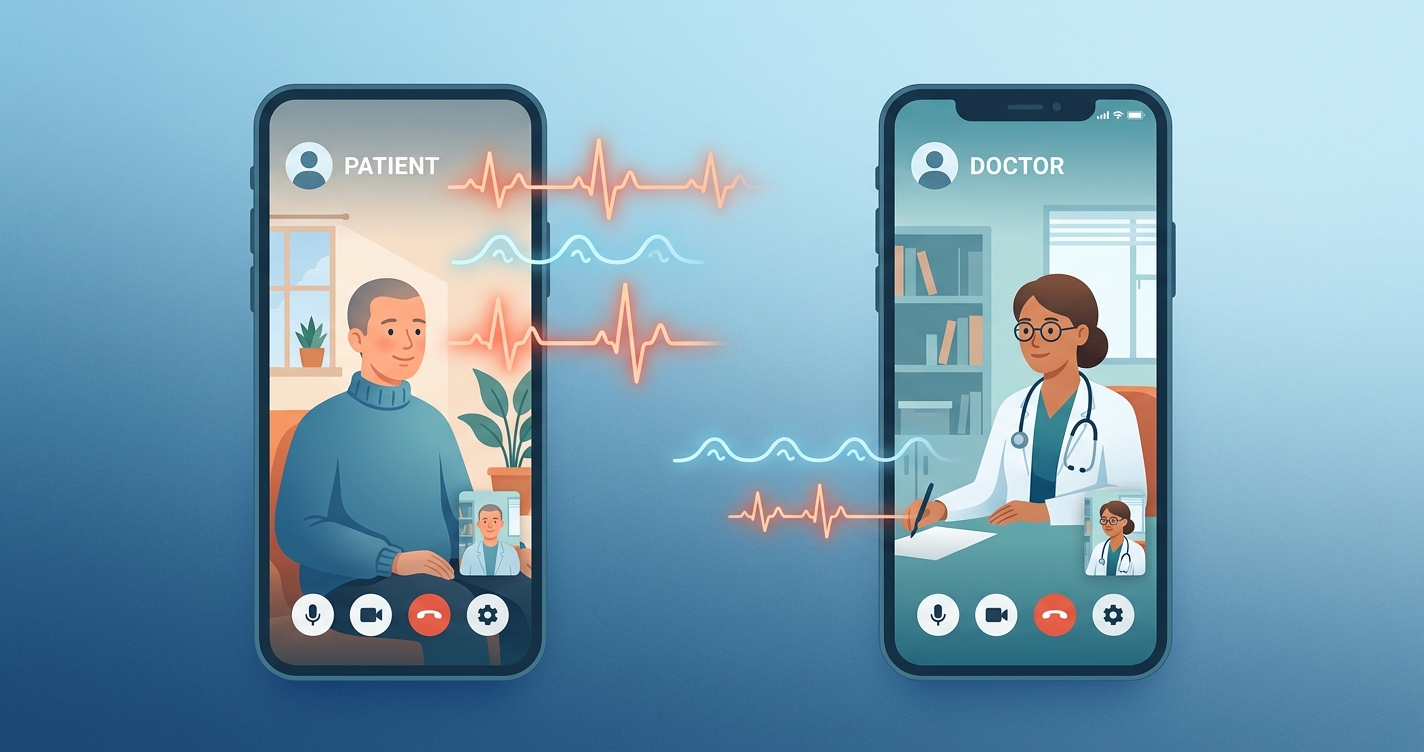
Every winter, telehealth platforms absorb a surge of seemingly minor complaints: a cough that will not quit, a cold that seems to be turning into something else, a child whose fever keeps climbing after bedtime. The clinical problem buried inside these routine visits is deceptively hard. A patient on a video call cannot tell a provider whether their respiratory rate has crept up or their heart is working harder than it should. This is where video visit vital signs become the difference between a reassuring conversation and a missed deterioration. Using only the camera already running in the call, remote photoplethysmography (rPPG) can estimate heart rate, respiratory rate, and other signals from subtle color changes in the skin, giving the clinician on the other end of the phone screen something closer to what they would measure in an exam room.
A 2024 study of England's national telehealth service found that seasonal respiratory infections drive sharp, predictable spikes in remote consultation volume, with influenza and RSV producing some of the steepest demand surges of the year. When millions of those contacts happen without any objective measurement, the burden of triage falls entirely on patient self-report.
Why video visit vital signs matter when a cold turns serious
The danger of a common winter illness is not the illness itself but its trajectory. A cold that resolves looks very different, physiologically, from one progressing toward pneumonia or a COPD exacerbation. The early warning signs are measurable: an elevated respiratory rate, a rising resting heart rate, and falling oxygen saturation often precede the symptoms a patient can describe. The problem for telemedicine software vendors is that the standard video visit captures none of these. The provider sees a face and hears a voice, then makes a disposition decision on subjective cues alone.
Video visit vital signs close that gap without asking the patient to buy, charge, or pair any hardware. The rPPG signal is extracted from the same video stream the platform already transmits. For a CTO or VP Engineering evaluating where to add clinical value, this is the rare feature that improves diagnostic context while reducing, rather than increasing, friction in the patient workflow.
| Monitoring approach | Hardware required | Captures vitals during a routine cold visit | Integration effort | Patient friction | | --- | --- | --- | --- | --- | | Self-report only | None | No objective data | None | Low | | Patient-owned peripherals (pulse oximeter, BP cuff) | Yes, per patient | Only if patient owns and uses correctly | Low to moderate | High | | Dedicated RPM device kits | Yes, shipped | Yes, but logistics-heavy | Moderate | High | | Camera-based rPPG SDK | None beyond existing camera | Yes, passively during the call | SDK integration into existing video stack | Very low |
The contrast that matters to a platform team is the bottom two rows. Device kits deliver data but carry shipping, onboarding, and return logistics that do not scale to the seasonal volume of cold and flu visits. A camera-based approach uses infrastructure already in place.
Key reasons this distinction drives platform decisions:
- Seasonal volume is unpredictable and spiky, so hardware fulfillment cannot keep pace.
- Most acute cold and flu visits are one-off encounters, making per-patient device shipping uneconomical.
- The relevant vitals for respiratory deterioration are exactly the ones rPPG estimates well: heart rate and respiratory rate.
- Passive capture means no extra step for an already unwell patient.
Industry Applications
Acute and urgent virtual care
The most direct application is on-demand urgent care, where winter respiratory complaints dominate the queue. Adding video visit vital signs gives the triaging clinician an objective respiratory rate and pulse to weigh against the patient's description. A resting respiratory rate climbing above normal is one of the earliest indicators that a cold is becoming a lower respiratory tract problem, and it is precisely the measurement patients cannot self-assess.
Chronic respiratory disease management
For patients with asthma or COPD, winter is the season of exacerbations. A 2024 systematic review in the Journal of Medical Internet Research examined remote patient monitoring and machine learning in acute exacerbations of COPD, noting that continuous or repeated vital sign capture supports earlier detection of deterioration. Telehealth platforms serving these populations can use camera-based capture during scheduled check-ins to track trends without mailing equipment to every enrolled patient.
Pediatric Telehealth
Parents on a late-night call cannot reliably count a child's breathing rate while also describing symptoms. Camera-based respiratory rate estimation gives pediatric platforms an objective number during the visit, which matters most when a fever and a cough are escalating overnight.
Current research and evidence
The evidence base for camera-based vitals has matured well beyond proof of concept. A 2026 clinical validation study published in MDPI's journals evaluated rPPG-enabled contactless pulse rate monitoring in cardiovascular disease patients and reported strong agreement with ECG, with a mean absolute error near 1.06 beats per minute. A separate 2025 study of a non-contact photoplethysmography mobile application found a mean absolute error close to 3 beats per minute for heart rate and around 2 percentage points for oxygen saturation, while blood pressure remained more variable.
Respiratory rate, the signal most relevant to a worsening cold, has its own supporting evidence. A hospital-based trial published on PMC concluded that rPPG is a reliable method to remotely measure respiratory rate, comparing camera-derived values against reference monitors. The 2024 VitalVideo dataset, the largest real-world rPPG dataset to date with 893 subjects across diverse skin tones, has given researchers a more representative basis for evaluation than earlier lab-only work.
The literature is also honest about limits. Researchers have documented that camera-derived heart rate estimates degrade at elevated heart rates and under motion or poor lighting, and that signal extraction is harder for darker skin tones without careful algorithm design. For platform teams, the practical takeaways are clear:
- Heart rate and respiratory rate are the most defensible signals for acute respiratory triage.
- Lighting guidance and motion handling in the UI directly affect signal quality.
- Skin-tone-inclusive validation is a procurement requirement, not a nice-to-have.
- Blood pressure from camera alone remains less settled and should be framed as a trend indicator.
The future of video visit vital signs
The near-term direction is integration depth rather than novel signals. As rPPG capture becomes a standard layer in the video stack, the value shifts to how vitals flow into clinical workflows: surfacing a rising respiratory rate to the provider in real time, writing structured results into the record using FHIR vital sign resources, and triggering follow-up when a trend crosses a threshold between visits. Longitudinal capture matters most for winter illness, because a single number is less informative than a three-day trajectory showing whether a cold is resolving or accelerating.
The seasonal economics also favor adoption. Because the marginal cost of capturing vitals through an existing camera approaches zero, platforms can extend objective measurement to the entire flu-season visit population rather than rationing it to high-acuity cases. Expect contactless capture to move from a premium add-on toward a baseline expectation of credible virtual care, with differentiation coming from accuracy under real-world conditions, inclusivity across skin tones, and clean integration into provider dashboards.
Frequently asked questions
Can a phone camera really tell if my cold is getting worse? A camera cannot diagnose, but it can estimate vital signs that indicate trajectory. A rising respiratory rate or resting heart rate captured during a video visit gives the clinician objective evidence that a cold may be progressing, rather than relying on symptom description alone.
Which vitals are most useful for respiratory illness over video? Respiratory rate and heart rate are the most relevant and best-supported by current research. Both can be estimated through rPPG during a normal call, and both are early indicators when an upper respiratory infection starts moving into the lungs.
Does the patient need any special device or app? No. Camera-based rPPG works from the standard video stream, so there is no pulse oximeter, cuff, or wearable to ship, charge, or pair. The measurement happens passively while the patient sits in front of the camera they are already using.
How accurate is camera-based measurement compared to a clinic device? Recent validation work reports close agreement with reference monitors for heart rate and respiratory rate under good conditions, while performance can drop with motion, poor lighting, or very high heart rates. Platforms should validate across diverse skin tones and treat some signals, like blood pressure, as trend indicators.
Circadify is building toward this exact need: a contactless rPPG SDK that adds real-time video visit vital signs to any telehealth platform without patient hardware, so providers can see when a routine winter cold is quietly getting worse. Teams evaluating integration can review the platform demo and SDK documentation at circadify.com/custom-builds.