Does My Online Doctor Know My True Pulse Without Touching Me?
An evidence review of telehealth pulse check accuracy, comparing contactless rPPG vitals against finger oximeters and ECG for telehealth platform teams.
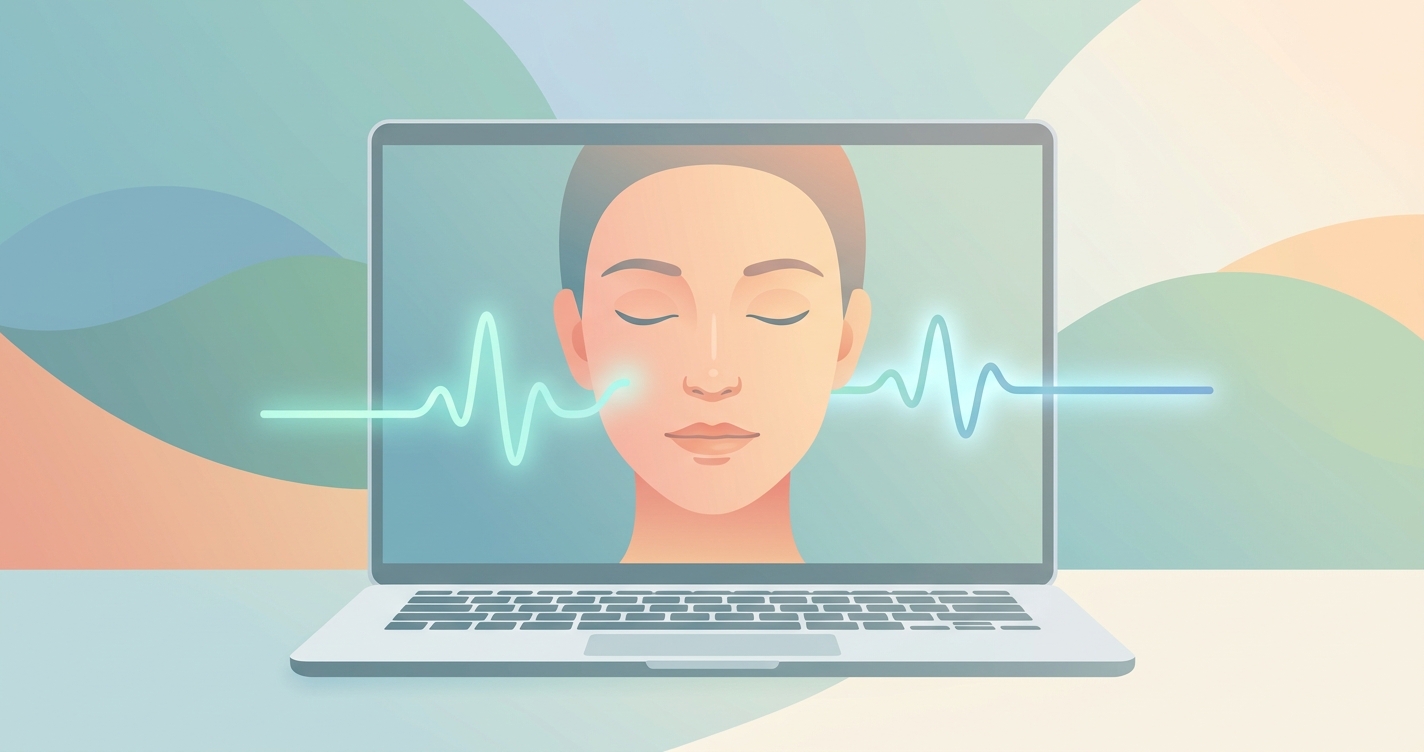
A patient sits in front of a laptop, the doctor a few hundred miles away, and a number appears on screen: 72 beats per minute. No cuff, no clip, no wearable. For most people the immediate reaction is doubt. How can a camera that never touches the skin report a pulse the patient can feel in their own wrist? That doubt is the central question telehealth platform teams must answer before they ship a vitals feature, and the honest version of the answer is more nuanced than either the skeptics or the marketing copy suggest. Telehealth pulse check accuracy is now a measurable, peer-reviewed property of remote photoplethysmography (rPPG), not a promise, and the published numbers are strong enough that the engineering conversation has shifted from "does it work" to "under what conditions, and how do we prove it to a procurement committee."
A 2023 clinical validation study of rPPG-enabled contactless pulse rate software reported a mean absolute error of 1.06 bpm against ECG in cardiovascular disease patients, a margin tighter than many clinicians expect from a contact device.
What telehealth pulse check accuracy actually measures
The physics behind the screen is older than telemedicine. Every heartbeat pushes a pulse of blood into the capillaries just beneath the skin of the face. That tiny volume change alters how much light the skin absorbs and reflects, mostly in the green channel of the visible spectrum. A standard webcam captures those minute color shifts frame by frame, and signal processing extracts the periodic waveform that corresponds to the cardiac cycle. This is remote photoplethysmography. A finger pulse oximeter does the same thing by shining its own light through tissue; rPPG simply reads ambient light reflected off the face, which is why no contact is required.
Telehealth pulse check accuracy, then, is not magic. It is the same optical principle as the device on a patient's fingertip, sampled at a distance. The difference is signal quality. A contact sensor sits against the skin with controlled illumination. A camera contends with room lighting, head movement, video compression, skin tone variation, and the patient talking through the visit. Each of these degrades the signal, and each is now a documented, quantifiable engineering variable rather than an unknown.
The research consensus is consistent on one point: for resting heart rate under reasonable conditions, contactless measurement lands within a clinically usable band. A systematic review and meta-analysis of consumer-grade contactless vital sign monitors, published in PMC, found that camera-based heart rate measurement agreed closely with reference devices, while cautioning that blood pressure and SpO2 require more validation. The accuracy is real and bounded, which is exactly what a CTO needs to know.
How contactless pulse compares to contact methods
The fairest way to evaluate telehealth pulse check accuracy is against the methods a clinic already trusts. The table below summarizes typical performance characteristics drawn from the validation literature.
| Method | Typical heart rate error (MAE) | Hardware required | Best use case | Main limitation | |---|---|---|---|---| | ECG (clinical reference) | Gold standard | Electrodes, monitor | In-clinic diagnostic | Not feasible for video visits | | Finger pulse oximeter | ~1-2 bpm | Fingertip clip | Spot checks at home | Patient must own and use device | | Contactless rPPG (resting, good light) | ~1-2 bpm | Existing webcam | Video visits, no hardware | Degrades with motion and poor light | | Contactless rPPG (talking or moving) | ~5-8 bpm | Existing webcam | Trend context, triage | Lower precision during motion | | Contactless rPPG (elevated heart rate) | Higher, variable | Existing webcam | Screening, not diagnosis | Accuracy falls at high rates |
Several findings inform the table:
- A 2023 study in cardiovascular disease patients reported a mean absolute error of 1.06 bpm for rPPG against ECG.
- Video-based PPG research has shown errors as low as 0.1 to 0.4 bpm when heart rate is averaged over 10 to 60 second windows in controlled settings.
- Performance drops measurably when subjects are talking, with reported errors near 8 bpm, and during body movement, near 5 bpm.
- Multiple reviews note reduced accuracy at elevated heart rates, a known constraint for any telemedical screening use.
The practical takeaway for platform teams: a resting pulse captured during a calm portion of a video visit is reliable enough to chart. A reading taken while a patient is animated, poorly lit, or on a frozen low-bandwidth connection should be treated as contextual, not diagnostic. Good products encode that distinction in the SDK through signal-quality scoring rather than hiding it.
Industry Applications
Virtual primary and urgent care
For routine video visits, resting heart rate is one of the simplest vitals to capture passively while the clinician takes a history. It adds objective data to encounters that previously relied entirely on patient self-report. A pulse trend over several visits, even at modest precision, tells a provider more than a single self-reported "my heart feels fast."
Chronic care and remote monitoring
In hypertension, heart failure, and post-discharge follow-up, the value is longitudinal. The clinical question is usually whether a patient is trending in the right direction, and a string of resting measurements answers that even when any single reading carries a few beats of uncertainty. Pairing pulse with respiratory rate and heart rate variability, both extractable from the same video stream, deepens the picture without adding devices.
Triage and intake
Automated intake flows can capture a baseline pulse before a clinician joins, flagging tachycardia or bradycardia for prioritization. Here the bar is detection, not diagnosis, and contactless capture removes the friction of asking a patient to find and use a device mid-crisis.
Current research and evidence
The evidence base has matured quickly. The 2023 clinical validation in cardiovascular patients is notable because it tested rPPG in a population with irregular rhythms and comorbidities, not healthy young volunteers, and still produced sub-2-bpm error. A University of Washington team, reported through UW News, developed a method using ordinary smartphone and computer cameras to extract pulse and respiration from facial video, and has pursued clinical collaborations to evaluate real-world performance, signaling that the academic community treats this as a deployable telehealth capability rather than a lab curiosity.
The Frontiers overview of contactless vital sign monitoring from digital camera video catalogs the same maturation, while being explicit about open problems. Two recur across the literature. First, performance is inferior on darker skin tones because the optical signal is weaker, an equity issue that responsible vendors must measure and disclose rather than average away. Second, motion and lighting remain the dominant error sources, which is why the most credible systems publish performance stratified by condition instead of a single headline number. The 2024 meta-analysis of consumer-grade monitors reinforced that heart rate is the most validated parameter, with blood pressure and oxygen saturation trailing and needing larger, more diverse trials.
For a platform CTO, the lesson is to demand condition-specific validation. A vendor that reports one accuracy figure with no mention of skin tone, motion, or lighting is hiding the variables that determine whether the feature survives contact with real patients.
The future of contactless pulse measurement
Three trajectories are visible. Algorithmic robustness is improving as deep-learning models trained on larger and more diverse datasets close the gap between controlled and uncontrolled conditions, including motion tolerance and skin-tone fairness. On-device processing is moving signal extraction to the patient's own hardware, reducing the bandwidth penalty and easing privacy and compliance burdens. And standardization is emerging, with FHIR-based vital sign resources giving platforms a clean path to store and exchange contactless readings alongside conventional ones, complete with provenance metadata that records how a measurement was taken.
The combined effect is that telehealth pulse check accuracy will increasingly be reported the way blood pressure already is: with a method, a condition, and a confidence interval attached. That is the maturity threshold regulators and clinicians expect, and the platforms that adopt it now will be the ones procurement teams trust later.
Frequently asked questions
Can a webcam really measure my pulse without touching me? Yes. A camera detects the small color changes in facial skin caused by each heartbeat, the same optical signal a fingertip oximeter reads. Under good lighting and with the patient still, published studies report heart rate error around 1 to 2 bpm against ECG.
Is contactless pulse measurement as accurate as a finger clip? For resting heart rate in good conditions, the accuracy is comparable, often within 1 to 2 bpm. Accuracy declines when the patient is moving, talking, poorly lit, or has a very high heart rate, so contactless readings are best treated as reliable trends rather than diagnostic certainties in those cases.
Why might my contactless reading vary between visits? Lighting, camera quality, head movement, video compression, and skin tone all affect signal quality. Well-built systems attach a confidence score to each measurement so providers can tell a high-quality resting reading from one captured under poor conditions.
Does it work for all patients equally? Not yet perfectly. Research consistently shows weaker signal quality on darker skin tones, and responsible vendors measure and disclose this rather than reporting a single averaged figure. Algorithmic improvements are actively narrowing the gap.
Circadify is building toward this standard of measurement, offering an rPPG SDK that adds real-time vital signs to video visits with no patient hardware and signal-quality scoring built in. Platform teams evaluating contactless vitals can review the architecture and integration details through the demo and SDK documentation at circadify.com/custom-builds.