Why Can't My Therapist See My Energy Levels During Our Video Chat?
A telehealth energy level monitor could give therapists physiological context during video visits. Here is what the vital sign data reveals and why platforms are integrating it.
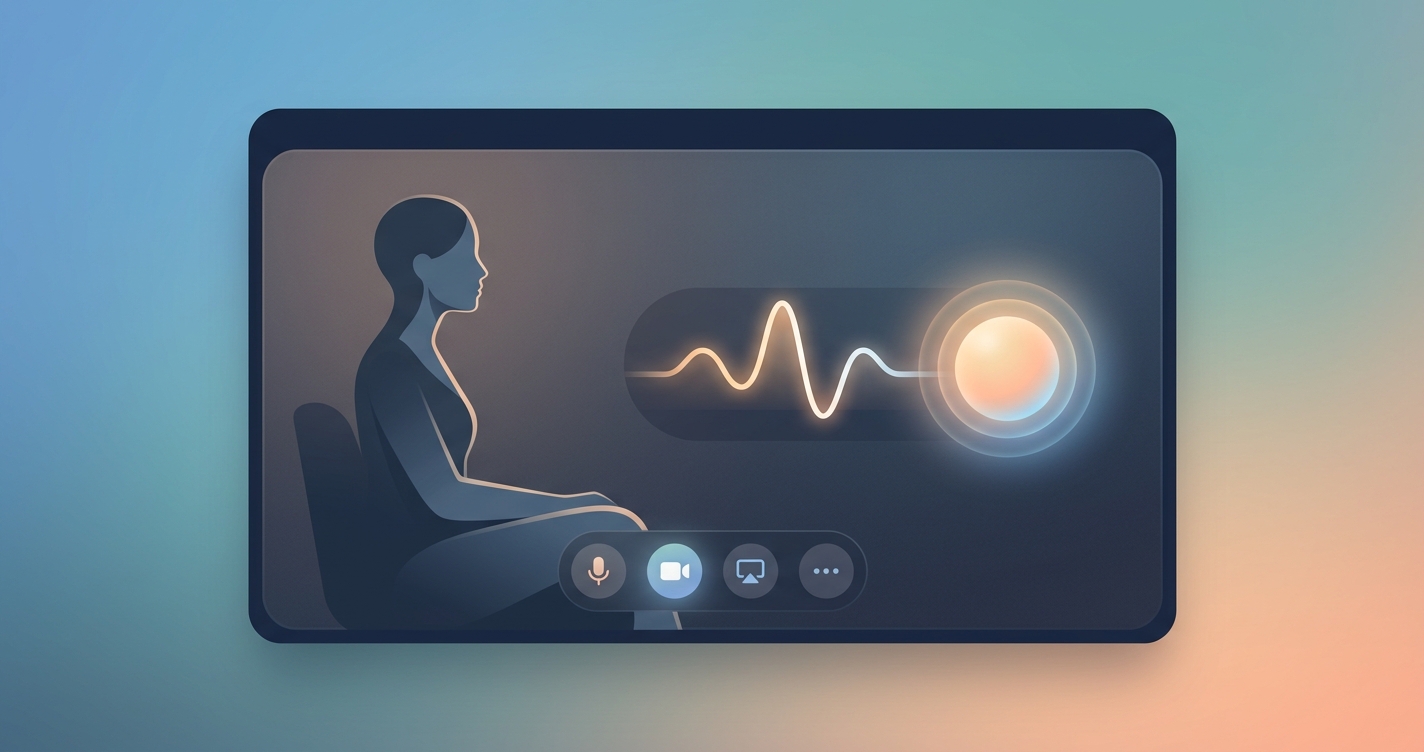
A patient sits in front of a webcam and tells their therapist they are "fine, just a little tired." The words are flat, the camera is unflinching, and the clinician has nothing to work with except tone and facial expression. The patient may be genuinely rested, or they may be running on the kind of depleted autonomic reserve that precedes a depressive relapse. Today, the therapist cannot tell the difference from a video feed. This gap is the quiet problem behind a growing question in virtual behavioral health: why is there no telehealth energy level monitor working in the background of a session, giving the clinician the physiological context that an in-person visit would naturally provide?
The answer is not that the science is missing. Energy, fatigue, and arousal leave measurable traces in the cardiovascular system, and those traces can be read from a face on camera. The answer is that most telehealth platforms were built to move video and audio, not to interpret the body sitting in front of the lens. That is beginning to change.
A 2023 systematic review of decreased heart rate variability across medical populations found that lower HRV was consistently associated with increased fatigue, spanning chronic fatigue syndrome, cancer-related fatigue, and post-viral conditions, positioning HRV as one of the most reproducible physiological correlates of subjective energy.
What a telehealth energy level monitor would actually measure
"Energy level" feels subjective, but the body encodes it in signals that are anything but vague. The most studied of these is heart rate variability (HRV), the beat-to-beat variation in cardiac rhythm governed by the autonomic nervous system. High HRV generally reflects a rested, recovered, parasympathetically dominant state. Suppressed HRV reflects stress, fatigue, illness, or the chronic dysregulation seen in mood and anxiety disorders. A telehealth energy level monitor does not detect a feeling. It detects the autonomic state that produces the feeling.
The technology that makes this possible during a video call is remote photoplethysmography, or rPPG. A standard camera captures tiny color changes in facial skin caused by blood volume shifts with each heartbeat. From that signal, software can derive heart rate, respiratory rate, and, with sufficient signal quality, HRV-derived metrics. No cuff, no chest strap, no wearable. The patient simply shows up to the visit they were already attending.
For behavioral health specifically, the relevant signals cluster into a few categories:
- Resting heart rate and its drift across a session
- HRV metrics such as RMSSD and SDNN that index autonomic balance
- Respiratory rate, which rises with anxiety and shallow breathing
- Pulse-derived arousal patterns that shift with emotional content
None of these replace clinical judgment. They give the clinician a second data stream alongside what the patient says and how they look.
How a physiological layer compares to words alone
The contrast between a self-report-only visit and one augmented with passive vitals is not subtle. The table below frames what each approach can and cannot surface.
| Dimension | Self-Report Video Visit | Video Visit With Passive Vitals Layer | |---|---|---| | Energy assessment | Patient's verbal description only | HRV and resting heart rate trend over time | | Anxiety detection | Visible cues plus disclosure | Respiratory rate and pulse arousal patterns | | Objectivity | Subject to recall and stigma | Continuous, passive physiological signal | | Longitudinal tracking | Notes and questionnaires | Quantified vitals across sessions | | Patient burden | None beyond attendance | None beyond attendance | | Hardware required | None | None, uses existing camera | | Risk of masking | High, patients minimize symptoms | Lower, physiology is harder to mask |
The decisive row is the last one. Patients in mental health care routinely minimize their symptoms, sometimes deliberately, sometimes because they have lost the ability to gauge their own state. A physiological layer does not call the patient a liar. It adds a signal the patient cannot easily suppress, and it does so without asking them to wear or do anything.
Industry applications for behavioral and holistic care
The value of a passive energy and arousal signal is not uniform across telehealth. It concentrates in services where the body and the mind are inseparable.
Depression and mood disorder follow-up
Fatigue and anhedonia are core features of major depression, and they are notoriously hard to track between visits. A clinician reviewing a patient's HRV and resting heart rate trend across six weekly sessions sees something a PHQ-9 score alone cannot show: whether the autonomic picture is improving in step with the self-reported mood, or diverging from it. Divergence is a clinical signal worth noticing.
Anxiety and panic management
Anxiety disorders show some of the clearest physiological signatures. A 2024 analysis of HRV in anxiety populations reported significantly reduced vagal tone compared with controls. During a session, a rising respiratory rate and falling HRV can mark the moment a patient enters acute distress, even when they keep talking in measured sentences. For exposure work and panic protocols, that timing matters.
Chronic fatigue and long-term conditions
Patients managing chronic fatigue syndrome, fibromyalgia, or post-viral fatigue live with energy as their central complaint. A 2023 secondary analysis of an HRV biofeedback trial in fibromyalgia found measurable changes in fatigue and energy levels tied to HRV intervention. For these populations, a telehealth energy level monitor turns the vaguest symptom they have into a number a care team can act on.
Integrated and collaborative care
Behavioral health is increasingly delivered alongside primary care. When a single video platform can pass physiological context to both the therapist and the physician, the two see the same patient rather than two disconnected accounts of one.
Current research and evidence
The research base sits on two pillars that are now converging. The first is the link between cardiovascular signals and psychological state. Work compiled by the American College of Sports Medicine and multiple peer-reviewed reviews has established HRV as an objective marker of mental health resilience, with reduced HRV appearing across stress-related fatigue, anxiety, and depression. Research on the time-on-task effect has shown that mental fatigue itself reduces parasympathetic activity in a way HRV captures, meaning the act of being depleted is visible in the signal.
The second pillar is the maturation of camera-based measurement. A 2024 review of remote photoplethysmography for telehealth described rPPG as a viable non-contact method for deriving heart rate and respiration from facial video, while flagging the open challenges the field still works on: accuracy across diverse skin tones, tolerance to lighting and motion, and clinical validation at scale. Parallel reviews of rPPG-based stress detection point to the same trajectory, using facial video to estimate arousal states that overlap heavily with the energy and anxiety signals behavioral health cares about.
The honest summary is that the physiology is well established and the contactless capture is advancing quickly but is not a solved clinical instrument. Signal quality on a real-world video call, with imperfect lighting and a moving patient, remains the engineering frontier. This is precisely why integration quality, not just the underlying algorithm, determines whether the data is useful.
The future of the telehealth energy level monitor
The trajectory points toward physiological context becoming an expected layer of serious telehealth rather than a novelty. Three shifts are likely to define the next few years.
- Passive becomes the default. The winning experiences will require nothing from the patient, capturing signal from the video already flowing.
- Trends matter more than snapshots. A single HRV reading is noisy. The clinical value lives in the trend across sessions, which means platforms must store and visualize longitudinal vitals.
- Clinician interpretation tools mature. Raw numbers help no one. Providers will need interfaces that translate autonomic data into something actionable in the flow of a 50-minute session.
The platforms that treat physiology as a first-class data stream, with the same care they give to video quality and scheduling, will set the standard for what a virtual behavioral health visit looks like.
Frequently asked questions
Can a webcam really measure energy levels during a therapy session?
A webcam cannot measure "energy" directly, but it can capture rPPG signals that yield heart rate, respiratory rate, and HRV. Because HRV is a well-documented correlate of fatigue and autonomic state, those metrics give a clinician an objective proxy for the energy and arousal a patient describes verbally.
Is physiological monitoring during video visits accurate enough to rely on?
Camera-based vitals are advancing but are not a finished clinical instrument. Accuracy depends on lighting, motion, skin tone, and integration quality. The current consensus from rPPG reviews is to treat these signals as supportive context that informs clinical judgment, tracked as trends over time rather than single diagnostic readings.
Would this replace what my therapist already does?
No. A telehealth energy level monitor adds a data stream alongside conversation and observation. It is most useful for catching divergence, when physiology and self-report disagree, and for tracking change across sessions. Clinical decisions stay with the clinician.
Does measuring vitals over video require the patient to wear anything?
No. The appeal of rPPG is that it uses the existing camera feed. The patient attends the session as usual, and the physiological layer runs passively in the background with no straps, cuffs, or separate devices.
Circadify is building toward exactly this future, developing a contactless rPPG SDK that lets telehealth and behavioral health platforms add real-time vital signs to the video visits they already run, no patient hardware required. Teams evaluating how to give clinicians a physiological view of the patient on screen can explore the platform demo and SDK documentation at circadify.com/custom-builds.