Solving Inaccurate Patient-Reported Vitals in Telehealth
Highlights the clinical and operational risks of relying on manually entered patient vitals and positions automated, contactless capture as the solution.
The expansion of virtual care has largely solved the problem of patient access. Today, patients can consult a clinician from any location, eliminating travel barriers and physical waiting rooms. The technology stack that powers these encounters has matured rapidly over the last decade, offering encrypted, low-latency video and secure asynchronous messaging. However, the resulting clinical encounters frequently stall when providers need objective data to inform a diagnosis or make a critical triage decision. Without an automated method for capturing physiological data, clinicians are forced to rely heavily on patient-reported measurements. For platforms building the next generation of virtual care, successful telehealth vital signs integration is the critical step to closing this data gap. The manual practice of patient reporting introduces significant clinical and operational risk, converting medical data collection into a highly subjective exercise dependent entirely on the patient's device quality, measurement technique, and memory. Telemedicine platforms must move beyond self-reported data to reach their full clinical potential and protect both patients and providers.
"When relying on manual techniques and uncalibrated home consumer medical devices, up to 80% of patients make at least one clinical error during self-measurement, severely reducing the sensitivity required to detect abnormal heart or respiratory rates.", Journal of the American Heart Association, 2022.
Solving the data gap with telehealth vital signs integration
For the majority of telehealth platforms operating today, the default approach to acquiring patient vitals has been a manual entry form presented before the consultation, or a verbal request initiated by the provider during the live video visit. While this workflow is structurally simple to build and deploy, it shifts the heavy burden of clinical data acquisition entirely onto the patient. When patients self-measure with a consumer smartwatch, an over-the-counter blood pressure cuff purchased years ago, or simply by counting their own pulse with two fingers, the data introduced into the clinical record is inherently flawed.
Patients routinely make fundamental errors during self-measurement. They place blood pressure cuffs over thick clothing, fail to support their arm at heart level, talk during the measurement process, or cross their legs, each of which can artificially inflate a reading by 10 to 15 millimeters of mercury.
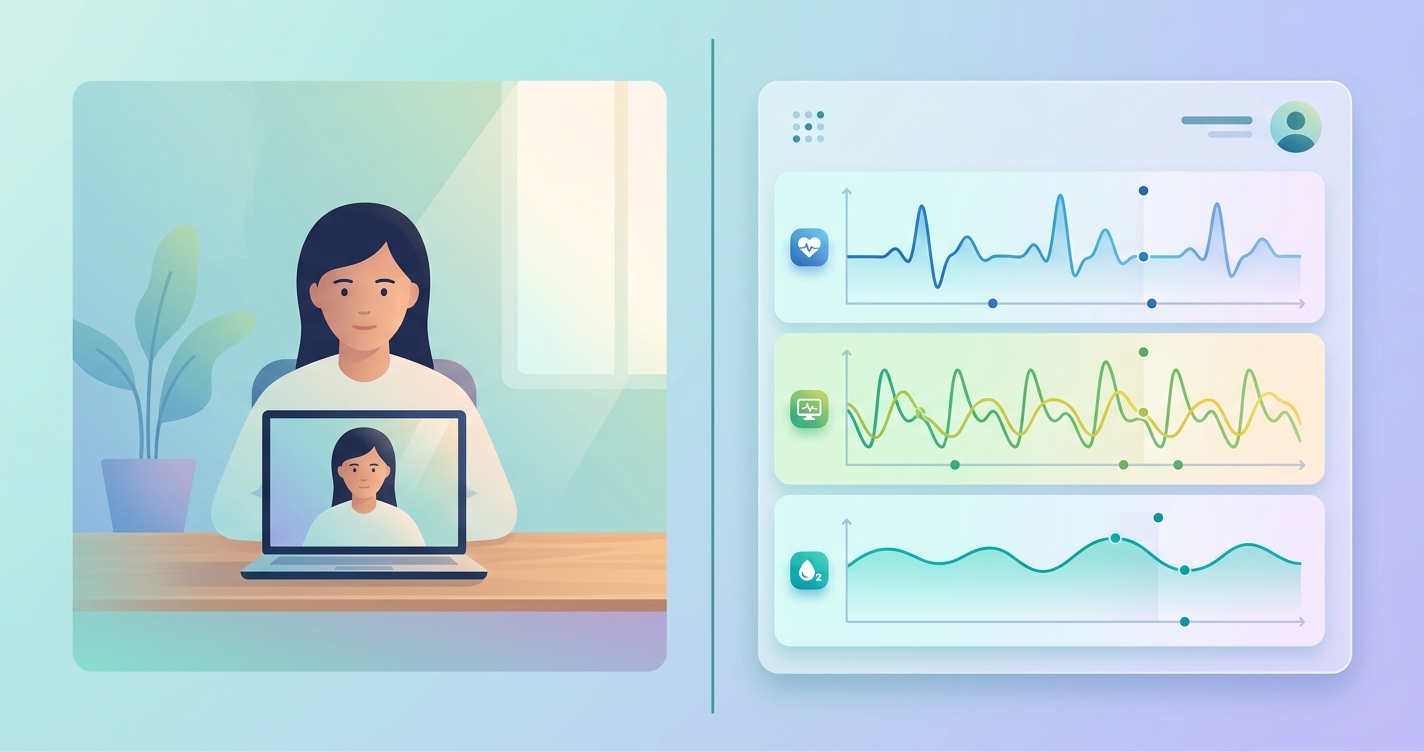
Implementing a direct telehealth vital signs integration fundamentally changes the reliability and safety of these virtual encounters. Rather than trusting that a patient correctly placed a cuff, rested for the appropriate five minutes prior to measurement, or accurately counted respiratory cycles over a full sixty seconds, platforms can extract physiological data directly through the active video feed. By utilizing remote photoplethysmography (rPPG), the software measures minute, invisible changes in light absorption on the patient's skin as blood flows. This technology calculates heart rate, respiration rate, and blood pressure trends without any hardware beyond the standard camera the patient is already using for the call.
This shift from active patient reporting to passive software extraction eliminates the friction that regularly breaks telemedicine workflows. Clinicians no longer have to base their medical decisions on a blood pressure reading taken by an improperly sized cuff, or a heart rate value that a patient estimated while feeling anxious about their symptoms. Instead, the video feed itself becomes a continuous clinical sensor.
| Data Capture Method | Clinical Reliability | Patient Burden | Hardware Requirement | Workflow Integration | | :--- | :--- | :--- | :--- | :--- | | Patient-Reported | Low (High risk of error) | High (Requires active participation) | Patient-owned devices (cuffs, watches) | Manual entry, often disjointed | | Mailed RPM Devices | Medium (Hardware failure risks) | Medium (Pairing and charging needed) | Platform-provided Bluetooth hardware | High cost, logistical overhead | | Contactless rPPG | High (Algorithmic consistency) | Zero (Passive capture during visit) | Standard smartphone or laptop camera | Direct API/SDK integration |
Replacing patient-reported inputs with automated software capture addresses several distinct failure points in telemedicine operations:
- Eliminates "digit preference," a well-documented phenomenon where patients round their numbers to the nearest zero or five, permanently corrupting the precision of the clinical record.
- Prevents clinical decisions based on uncalibrated, expired, or improperly fitted consumer hardware purchased by the patient.
- Reduces visit durations by removing the valuable minutes spent waiting for patients to locate devices, position them, or read numbers aloud to the provider.
- Standardizes data formats across the platform, ensuring that vitals flow smoothly and reliably into FHIR-compliant electronic health records without manual transcription errors.
- Lowers the cognitive load on the provider, who can focus entirely on the patient's visual cues and verbal history rather than interrogating the validity of a reported number.
Industry applications of automated vitals
Primary care and urgent triage
In virtual primary care and urgent telehealth settings, the initial moments of a visit dictate the entire clinical path. When a patient reports feeling unwell, a provider must quickly determine if the condition is safely manageable at home with conservative treatment or if it requires an immediate emergency department transfer. Patient-reported vitals often result in defensive medicine. If a patient reports a heart rate that seems dangerously high simply because they miscounted their pulse while panicked, the provider has no choice but to escalate the case to an in-person facility. Passive capture provides the objective, real-time baseline needed for accurate, safe triage, keeping lower-acuity patients out of the emergency room.
Chronic disease management
Managing long-term conditions like hypertension, diabetes, or congestive heart failure relies entirely on consistent, reliable data collection over time. When patients are asked to manually log their vitals every day or week, adherence predictably drops after the first few weeks, and the quality of the data degrades as patients rush through the burdensome process. Integrating passive vital sign capture directly into the check-in workflow means providers receive a reliable, standardized reading every time the patient connects for a routine virtual check-up. This bypasses the friction of daily manual logging and gives the clinician a highly accurate snapshot of the patient's physiology in that exact moment.
Mental health and psychiatry
Psychiatric medication management often requires monitoring physical vital signs, particularly blood pressure and heart rate, which can be affected by stimulants, antidepressants, or other psychotropic drugs. Patients seeking mental health support are rarely equipped with home medical hardware, and asking them to purchase and use blood pressure cuffs can cause unnecessary stress and anxiety. Passive camera-based extraction allows psychiatrists to monitor the physiological effects of medications safely and quietly, without requiring patients to actively perform measurements that might distract from the therapeutic and conversational nature of the session.
Current research and evidence
The clinical limitations of patient-reported data and home consumer devices are extensively documented across modern medical literature. A 2024 study published in JMIR Formative Research by researchers Julian Gerald Dcruz and Paichang Yeh at Docsun Biomedical Holdings validated the accuracy of contactless telehealth portals against clinically approved, hospital-grade medical devices. The researchers found that automated, camera-based measurements successfully met predefined clinical cutoffs for heart rate, oxygen saturation, and blood pressure, significantly outperforming manual patient estimation techniques in both reliability and consistency.
Extensive analysis of home monitoring techniques reveals critical gaps in patient-led data collection. Research indicates that when patients estimate their own respiratory rate or pulse without automated devices, their sensitivity for detecting elevated, abnormal rates drops drastically. Some clinical reviews show sensitivity dropping as low as 25% for pulse estimation. This severe lack of sensitivity confirms that while patients can sometimes accurately report obvious, extreme abnormalities, they frequently miss the subtle physiological shifts that precede a severe clinical event.
Furthermore, data from the American Heart Association regarding home blood pressure monitoring reveals that standard patient errors, such as variations in arm position, speaking during the measurement, or using the wrong cuff size, can alter a reading dramatically. When a telehealth platform relies on this unverified data, it bakes these errors directly into the patient's permanent electronic health record, creating a faulty foundation for all future medical decisions.
The future of telehealth measurement
The trajectory of virtual care points clearly toward complete clinical equivalence with in-person visits. Achieving this equivalence requires completely removing the patient from the role of clinical data gatherer. The future of telehealth operations involves ambient, invisible clinical measurement, where the software infrastructure of the platform itself generates the precise medical context the provider needs to do their job safely and effectively.
Engineering teams at telehealth companies will increasingly treat vital signs not as an operational logistics problem, mailing out peripheral devices, managing hardware inventory, or troubleshooting Bluetooth connections over the phone, but as a pure software integration requirement. By embedding advanced extraction algorithms directly into the real-time video pipeline, platforms will standardize the quality of their clinical encounters globally. This architectural shift protects providers from the medical liability of acting on bad data while drastically lowering the barrier to entry for patients seeking high-quality, frictionless virtual care.
Frequently asked questions
Why are patient-reported vital signs considered unreliable in telemedicine?
Patients frequently use improper measurement techniques, fail to calibrate their home devices, or experience acute anxiety during self-measurement. Furthermore, patients often round their numbers up or down, or misremember them when entering data into a platform portal, leading to a complete loss of clinical precision and creating potential liability for the diagnosing provider.
How does an rPPG SDK integrate into existing virtual care platforms?
An rPPG SDK embeds directly into the platform's mobile or web application. During the video visit, it analyzes the pixel data from the patient's camera to detect micro-vascular blood volume changes, calculating vital signs on the fly and passing the structured data securely to the provider's dashboard via a simple API.
Do patients need specialized hardware to use contactless vitals?
No. The technology relies entirely on the standard RGB cameras built into modern smartphones, tablets, and laptops. The processing occurs either on the device edge or via secure cloud servers, requiring zero additional hardware purchases, device pairing, or manual setup from the patient.
Does removing manual entry improve telehealth consultation times?
Yes. Waiting for patients to locate their home devices, properly position them, and read the results aloud consumes valuable minutes during a consultation. Passive capture operates silently in the background while the provider takes the clinical history, heavily optimizing the visit's total duration and allowing clinicians to see more patients per shift.
For engineering and clinical leaders tired of the liability and inefficiency of patient-reported data, Circadify provides the exact infrastructure needed to upgrade your platform. By enabling automated, contactless vitals capture, you remove the burden from patients and deliver objective data straight to your clinicians. To see how seamless this integration can be for your virtual care environment, explore our platform demo and SDK documentation at circadify.com/custom-builds.