How Can I Prove I'm Getting Better to My Doctor From My Phone?
Patients want objective telehealth progress vital signs during follow-up video visits. Here is why contactless capture matters for platforms and providers.
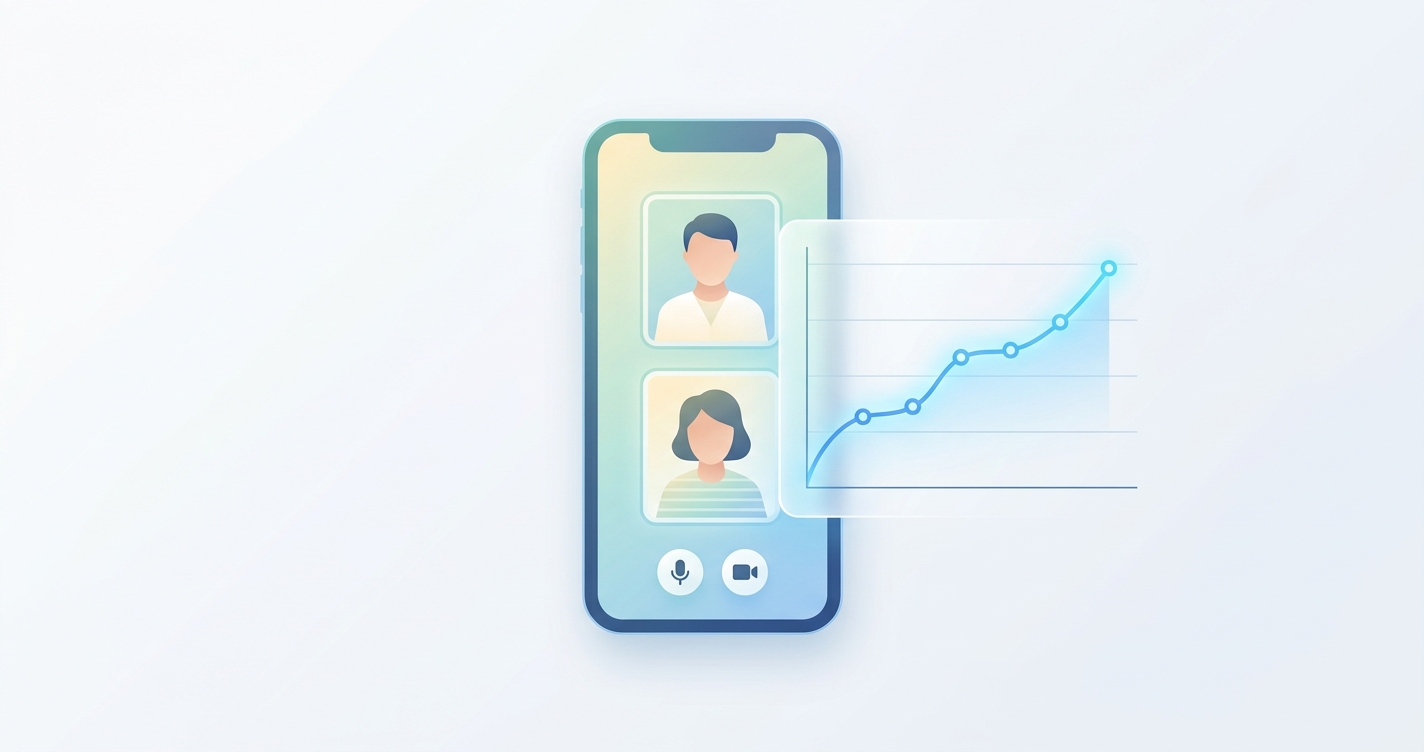
A patient who has spent six weeks adjusting medication, changing their diet, or recovering from an acute episode arrives at a follow-up video visit with one quiet goal: to show that the work paid off. The trouble is that most virtual care platforms give them no way to do it. They can describe how they feel, but they cannot point to a number. This gap is where telehealth progress vital signs have become a defining product question, because patients increasingly expect to share objective evidence of improvement, and providers increasingly need that evidence to make confident remote decisions. For telehealth software vendors, the absence of a measurable trend line during follow-up is no longer a minor feature gap. It is a credibility problem that shapes whether a virtual visit feels clinical or merely conversational.
"The number of healthcare providers enrolling in national patient-generated health data platforms rose sharply after the shift to telemedicine, with PGHD increasingly used as a surrogate for in-person vital sign collection." - Patient-Generated Health Data analysis, published in PMC (2023)
Why telehealth progress vital signs decide whether a follow-up feels clinical
The core friction in virtual follow-up care is that subjective recovery and objective recovery do not always move together. A patient may report feeling worse while their resting heart rate and blood pressure trend in a healthy direction, or report feeling fine while a measurable signal drifts the wrong way. Without telehealth progress vital signs captured at each appointment, the provider is left reconstructing a trend from memory and self-report. That is a weak foundation for adjusting a treatment plan, and patients sense it.
Patient-generated health data (PGHD) has been positioned as the answer, and adoption climbed quickly through the telemedicine transition documented in PMC research (2023). But most PGHD today depends on the patient owning and correctly using a separate device: a cuff, a pulse oximeter, a wearable. Each piece of hardware introduces a point of failure. The patient forgets to charge it, measures incorrectly, or simply does not own one. The result is inconsistent data that providers learn to distrust.
Contactless capture changes the economics of this problem. Remote photoplethysmography (rPPG) reads subtle color changes in facial skin through the same camera already running the video visit, which means a vital sign reading can happen inside the appointment with no extra device. For platform teams, the strategic point is simple: the measurement that proves a patient is improving should be built into the visit, not outsourced to whatever hardware the patient happened to buy.
Comparing how patients can document recovery between visits
The methods available to a patient who wants to demonstrate progress differ sharply in reliability, cost, and how cleanly the data lands in a provider's workflow.
| Method | Patient hardware needed | Data consistency | Fits inside video visit | Provider trust | | --- | --- | --- | --- | --- | | Verbal self-report | None | Low | Yes | Low | | Patient-owned cuff or oximeter | Dedicated device | Medium, depends on technique | No, captured separately | Medium | | Consumer wearable export | Wearable plus app | Medium, variable formats | Partial | Medium | | Manual paper or app log | None to minimal | Low to medium | No | Low | | Contactless rPPG during the visit | None, uses camera | Standardized per session | Yes | Higher with consistent capture |
The pattern across these options is consistent. The methods that produce the most trustworthy data also impose the most burden, and burden is what erodes adherence over a multi-week recovery. Contactless capture is the only row that combines no patient hardware with measurement taken inside the visit itself, which is why it maps so cleanly onto follow-up workflows.
Key reasons this matters for platform decision-makers:
- A trend line built from identical measurement conditions is more interpretable than one stitched together from mixed devices.
- Removing patient hardware removes the most common reason vitals data is missing at follow-up.
- Capturing the reading during the visit keeps the data inside the clinical encounter, where documentation and reimbursement already live.
- Standardized in-visit capture reduces the support burden of troubleshooting third-party devices.
Industry applications for in-visit progress capture
Chronic disease follow-up
Conditions such as hypertension and heart failure are managed over months of incremental adjustment. A patient titrating blood pressure medication wants visible proof that the change is working, and the provider needs the same proof to justify the next step. In-visit capture creates a session-by-session record that both sides can read as a recovery curve rather than a single isolated number.
Post-acute and post-discharge recovery
After a hospitalization or acute event, the highest-risk window is the weeks of recovery at home. Follow-up visits during this period carry real clinical weight. Letting the patient see their own resting heart rate trending toward baseline turns an anxious check-in into a reassuring one, and gives the provider an objective signal to confirm the patient is on track.
Behavior-change and wellness programs
Programs built around exercise, stress reduction, or weight management struggle with the same measurement problem as clinical care. Participants want evidence that effort is producing physiological change. Capturing vitals at each touchpoint gives coaches and clinicians a shared, objective progress metric instead of relying solely on how the participant says they feel.
Medication management and titration
Dose adjustments depend on monitoring response. When a provider can compare vitals captured under consistent conditions across visits, they can make titration decisions with more confidence and fewer redundant in-person checks.
Current research and evidence
The clinical case for contactless capture has strengthened as rPPG validation has matured. Work compiled in PMC (2024) on rPPG-enabled contactless pulse rate monitoring in cardiovascular disease patients reported a mean absolute error near 1.06 bpm against reference devices, indicating that camera-based heart rate can approach contact measurement under suitable conditions. Broader validation summarized in MDPI's systematic review of non-contact vision-based vital sign monitoring (2023) describes consistent heart rate accuracy alongside more variable results for blood pressure, which remains the harder parameter to extract reliably.
On the demand side, the PGHD analysis in PMC (2023) documented that providers adopted patient-generated data rapidly once telemedicine scaled, treating it as a stand-in for in-clinic vitals. Research on appointment completion adds a complementary point: a retrospective cohort study found telemedicine appointments were more likely to be completed than in-person visits, largely because barriers like transportation and childcare disappear. Together these findings describe a system where patients are showing up to virtual follow-ups in large numbers but often arrive without the objective data that would make those visits clinically decisive.
The honest limitation is that camera-based measurement is sensitive to movement, lighting, skin tone, and video compression, as the MDPI review and related arXiv work on artifact mitigation (2024) make clear. Reliable progress tracking depends on capturing readings under reasonably consistent conditions, which is precisely why building capture into a controlled, repeatable visit flow matters more than treating it as a passive background feature.
The future of telehealth progress vital signs
The direction of travel points toward progress measurement becoming a standard expectation of virtual follow-up rather than a premium add-on. Several shifts are converging:
- Patients are arriving with self-tracked data already and expecting platforms to receive and interpret it, raising the bar for what a follow-up visit should produce.
- Reimbursement structures continue to reward documented remote monitoring, giving platforms a financial reason to capture objective vitals inside the encounter.
- AI-assisted triage and trend detection work best when fed consistent session-over-session data, making standardized in-visit capture a prerequisite rather than a nice-to-have.
- As validation literature accumulates, the conversation moves from whether camera vitals can be captured to how cleanly they integrate into existing clinical workflows.
The platforms that treat objective progress as a core part of the follow-up experience, rather than something the patient must assemble from outside devices, will set the expectation that other vendors are measured against.
Frequently asked questions
Can a patient really show measurable improvement through a phone during a video visit? Yes, when the platform captures vitals during the call. Contactless rPPG reads heart rate and related signals through the camera already in use, so a patient can produce an objective reading at each follow-up without owning a separate device. Captured consistently across sessions, those readings form a trend a provider can interpret as progress.
Why not just have patients use their own blood pressure cuff or wearable? Patient-owned devices work for some, but they introduce dependence on the patient owning, charging, and correctly using hardware. That inconsistency is the main reason vitals data is missing at follow-up. In-visit capture removes the hardware barrier and standardizes the conditions under which each reading is taken.
How accurate is camera-based vitals capture for tracking progress? Validation research in PMC (2024) reported heart rate mean absolute error near 1.06 bpm against reference devices in cardiovascular patients, while reviews note blood pressure remains harder to extract reliably. For progress tracking, consistency of measurement conditions across visits is as important as single-reading accuracy.
What does this mean for telehealth platform vendors? It reframes vitals from an optional feature into part of what makes a follow-up visit clinically credible. Building contactless capture into the visit flow lets platforms offer objective progress data without shipping hardware, which strengthens both patient experience and provider confidence.
For telehealth platform companies and engineering leaders weighing how to bring objective progress data into follow-up visits, Circadify is building toward exactly this space: an rPPG SDK that adds real-time, contactless vital signs to an existing video visit with no patient hardware required. Explore the platform demo and SDK documentation at circadify.com/custom-builds to see how in-visit capture can fit your workflow.