Will My Online Doctor Know My Stress Level Just By Looking at My Face?
Can a video doctor read your stress from your face? How telehealth vital signs and contactless rPPG turn facial signals into objective stress data.
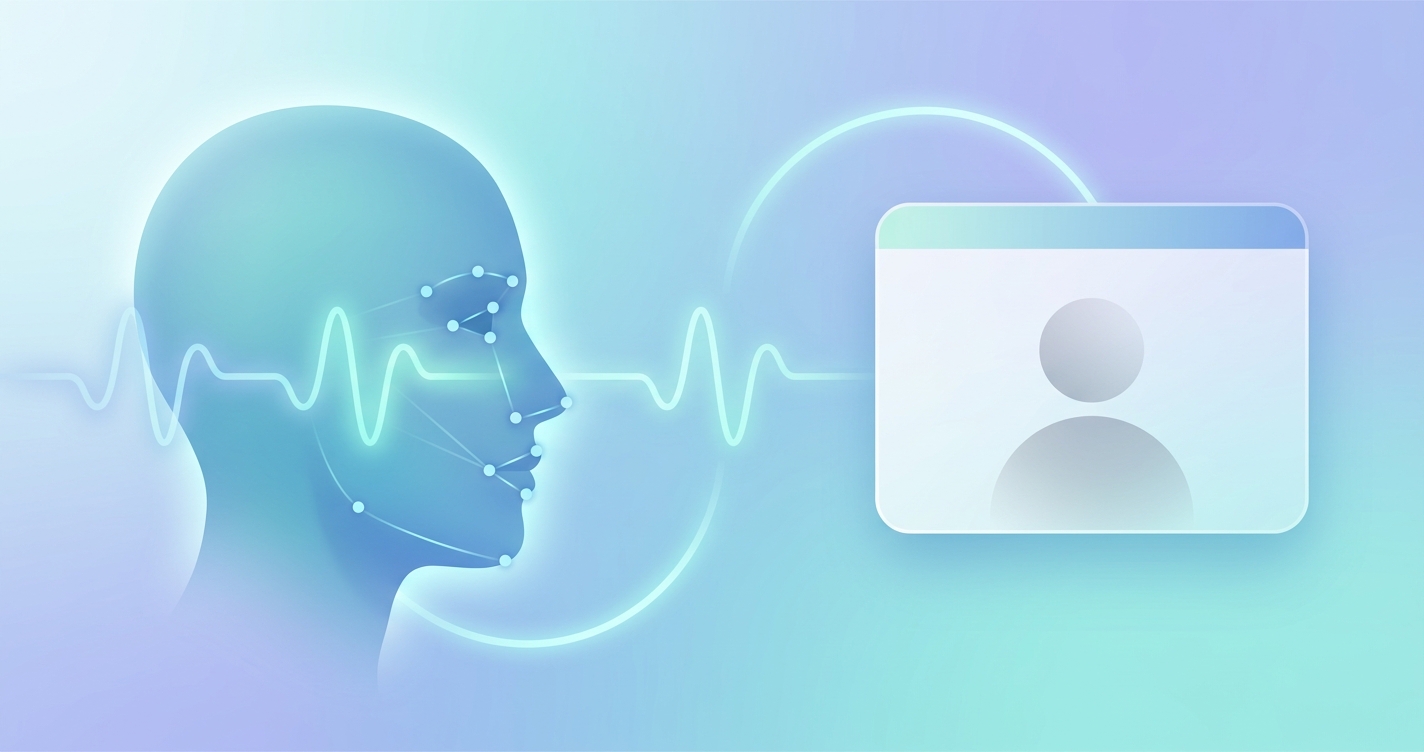
Patients walking into a video consultation often carry a quiet worry that has nothing to do with their presenting complaint: can the person on the other side of the screen actually tell how they are doing? Not the words they rehearse, but the tension in the jaw, the shallow breathing, the racing pulse behind a composed expression. The question of whether an online doctor can read stress from a face is no longer purely philosophical. It sits at the intersection of camera hardware, signal processing, and the maturing field of telehealth vital signs, where the same webcam that streams a consultation can also extract physiological data the human eye cannot see.
A 2023 multimodal study reported binary stress classification accuracy of up to 95.21 percent using deep learning on facial signals, a figure that reframes stress from a subjective impression into a measurable signal.
What telehealth vital signs reveal about stress
The short answer to the patient's question is layered. A clinician watching a video feed reads stress the way any attentive observer does: facial expression, posture, tone, pacing of speech. That impression is real but unreliable, shaped by lighting, cultural display rules, and the patient's effort to appear composed. What changes the equation is the addition of telehealth vital signs captured directly from the video stream through remote photoplethysmography, or rPPG.
rPPG works by detecting minute color changes in facial skin caused by blood flowing beneath the surface with each heartbeat. From that signal, software can estimate heart rate, respiratory rate, and crucially, heart rate variability (HRV), the beat-to-beat fluctuation that reflects autonomic nervous system balance. Stress shifts that balance toward sympathetic dominance, and HRV drops in characteristic ways. So when a patient asks whether their doctor can see their stress level, the more precise answer in 2026 is that the platform may be able to measure the physiological correlates of stress, even when the face stays calm.
This distinction matters. Facial expression analysis infers emotion from what a face shows. rPPG-derived vitals measure what the body is doing regardless of expression. The strongest emerging approaches combine both, treating the visible and the invisible as complementary streams.
| Stress Signal | What It Measures | Source | Vulnerability | | --- | --- | --- | --- | | Facial expression analysis | Visible emotional display | Camera + computer vision | Masking, cultural display rules, lighting | | Heart rate (rPPG) | Cardiac rate during the visit | Skin color change in video | Motion, low bandwidth, skin tone variation | | Heart rate variability | Autonomic balance, stress load | rPPG beat-to-beat timing | Requires stable signal, longer capture window | | Respiratory rate | Breathing pattern, anxiety markers | Chest motion or rPPG modulation | Camera framing, clothing | | Self-report | Conscious emotional state | Patient questionnaire | Recall bias, social desirability |
A holistic stress assessment draws on several of these at once. No single channel is sufficient, but layered together they give a clinician something closer to the in-person experience of reading a patient.
- Facial expression alone is fast but easily masked.
- HRV is harder to fake but needs a clean, longer signal window.
- Respiratory rate adds an independent anxiety marker.
- Combining channels reduces the error of any one method.
- Self-report remains essential for context and consent.
Industry applications for emotional state detection
For telehealth platform companies, the value of reading stress is not novelty. It is the chance to close a gap that has limited virtual care since its expansion: the loss of the embodied, observational data a clinician gathers naturally in a physical room.
Behavioral and mental health
Mental health teleconsultation is the most obvious fit. A therapist who can see a corroborating HRV trend alongside a patient's self-described anxiety gains an objective anchor. Research on systems such as TheraSense (2023) explored deep learning for facial emotion analysis specifically in mental health teleconsultation, pointing to a workflow where emotional signals supplement rather than replace clinical judgment.
Chronic disease and primary care
Stress is a confounder in hypertension, diabetes, and cardiac care. A blood pressure reading taken during an acutely stressful visit tells a different story than a baseline one. Telehealth vital signs that flag elevated autonomic arousal help clinicians contextualize other measurements rather than misread them.
Triage and remote monitoring
In high-volume virtual urgent care, an objective stress or distress indicator can help prioritize patients whose calm verbal report masks physiological strain. The signal becomes one more input to safer triage, not a diagnosis on its own.
Current research and evidence
The research base behind emotional state detection has moved quickly. A 2023 multimodal stress study using facial landmarks reported emotion detection accuracy up to 81.65 percent and binary stress detection up to 93.20 percent with classical machine learning, rising to 84.32 percent and 95.21 percent respectively with deep learning. Multimodal systems integrating several data sources have reported stress detection accuracy as high as 98.38 percent under controlled conditions.
Work specific to consultation settings shows similar momentum. An AI-driven healthcare system analyzing facial expression and speech during video consultations reported roughly 92 percent accuracy for basic emotion recognition using convolutional neural networks, increasing to about 94 percent when speech analysis was added. A 2023 review of facial recognition algorithms for mental health in older adults found high overall detection accuracy, with an effect size of 0.84.
On the physiological side, rPPG for HRV has advanced from heart rate alone toward the finer-grained timing that stress assessment requires. The Remote Learning Affect and Physiology (RLAP) dataset, released in 2024, provided more than 32 hours of synchronized video and labels from 58 subjects for training HRV models, and the Seq-rPPG model introduced the same year demonstrated efficient HRV extraction. Earlier algorithmic work, including WaveHRV (2023) using a Wavelet Scattering Transform, addressed the core difficulty of robust contactless HRV from facial video. The Vision-based Remote Physiological Signal Sensing challenge at IJCAI 2024 kept pushing remote heart rate sensing from unlabeled video.
The honest caveat across this literature is consistent. Reported accuracies come largely from controlled datasets. Real consultations bring motion, variable lighting, low bandwidth, and the full range of human skin tones, all of which degrade performance. Cultural differences in facial display and the ethics of inferring emotion add further constraints. These are engineering and governance problems, not reasons to dismiss the approach.
The future of telehealth vital signs and stress detection
The trajectory points toward stress assessment as a passive, continuous byproduct of the video visit rather than a separate test. Several shifts are likely to define the next few years.
- Fusion by default: platforms will combine rPPG vitals, facial expression, and voice rather than relying on any single channel.
- Trend over snapshot: stress will be reported as a change from a patient's own baseline, which is more clinically meaningful than an absolute label.
- Transparency and consent: patients will need to know when emotional inference is active, with clear opt-in controls.
- Bias auditing: validation across skin tones, ages, and lighting will become a procurement requirement, not an afterthought.
- Clinician framing: outputs will be positioned as decision support, never as automated diagnosis of emotional state.
For platform builders, the strategic question is not whether stress signals are perfectly accurate today. It is whether their architecture can ingest these signals responsibly as the models mature, so the platform reflects the patient's state instead of guessing at it.
Frequently asked questions
Can my online doctor really tell my stress level just from my face?
A clinician can form an impression from your expression, but that impression is easy to mask. What is changing is the ability of telehealth platforms to measure physiological correlates of stress, such as heart rate variability extracted from your video through rPPG, which reflect autonomic arousal even when your face appears calm.
Is stress detection from a webcam accurate?
Controlled studies report high accuracy, with deep learning reaching binary stress classification above 95 percent in some 2023 research. Real-world performance is lower because motion, lighting, bandwidth, and skin tone variation degrade the signal. It is best treated as supporting evidence, not a standalone diagnosis.
Do I have to consent to emotional analysis during a video visit?
Responsible platforms make emotional state detection opt-in and disclose when it is active. Consent, transparency, and the right to decline are central ethical requirements identified across the research, alongside privacy protections for the underlying video data.
Does this replace what an in-person doctor observes?
No. The goal is to recover some of the observational data lost in virtual care, not to substitute for clinical judgment. Telehealth vital signs and emotional signals give clinicians an objective anchor that complements the conversation and the patient's own report.
Circadify is addressing this space by helping telehealth platforms add contactless vital signs, including the heart rate and HRV signals that underpin objective stress assessment, captured during ordinary video visits with no patient hardware. Platform teams exploring emotional state detection as part of a more holistic patient assessment can review the integration approach and SDK documentation at circadify.com/custom-builds.