Why Can't My Kids' Online Doctor See Their Fever Before It's Too Late?
A research view of the kids telehealth temperature check gap and how contactless vital signs during pediatric video visits close the safety blind spot for families.
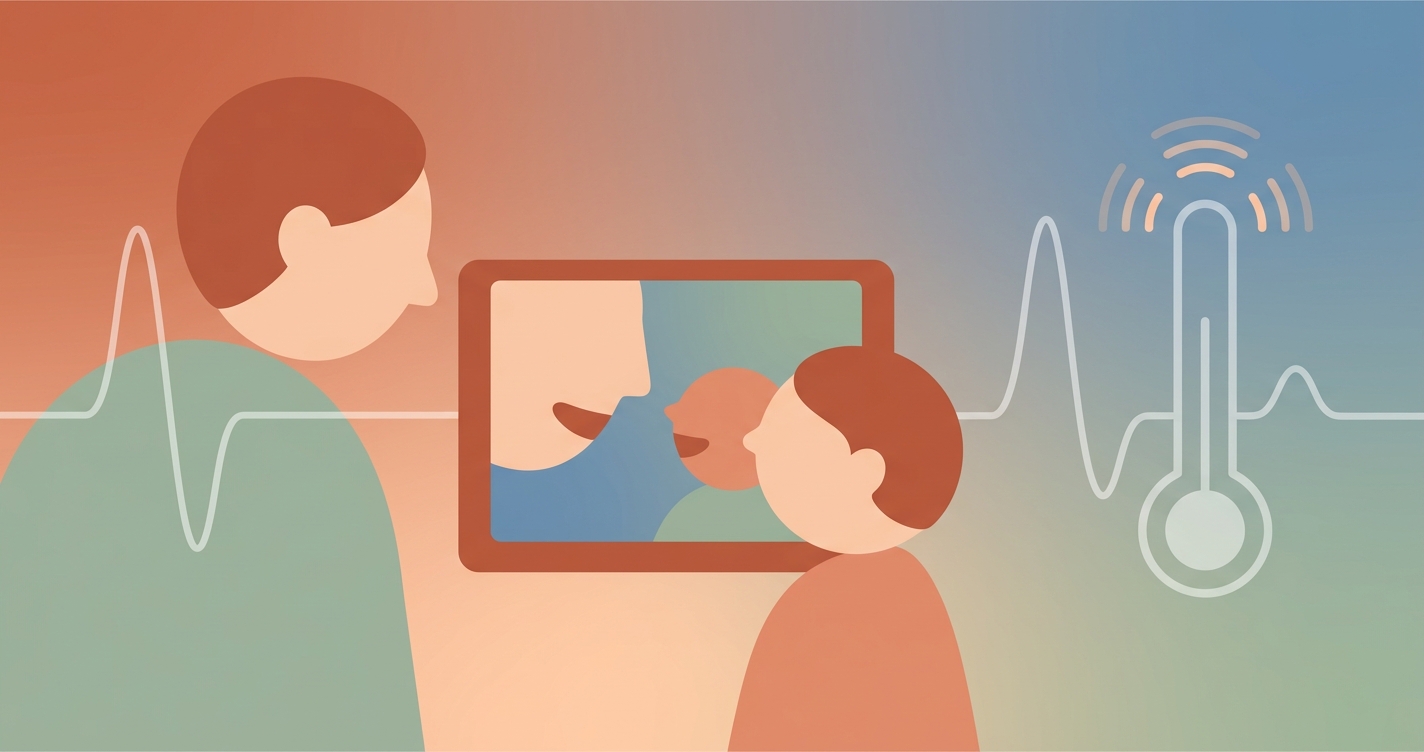
A parent on a late-night video call with a pediatrician is usually doing one thing the platform cannot: pressing a hand to a child's forehead and guessing. The clinician on the other end is making decisions about a feverish toddler using a caregiver's verbal report, a slightly blurry webcam, and clinical intuition. For most acute pediatric visits, the single most important data point that drives escalation, fever, arrives as hearsay rather than measurement. That gap is the core of the kids telehealth temperature check problem, and it is becoming the defining clinical and product question for any platform serving families. Parents feel it as anxiety. Platform teams should read it as an unmet specification.
A systematic review and meta-analysis of contactless photoplethysmography in pediatrics by Lyra and colleagues found pooled neonatal heart rate bias of just -0.25 beats per minute (95% limits of agreement -1.83 to 1.32), evidence that camera-based vital signs can reach clinically meaningful agreement even in the hardest pediatric populations.
The reassuring news from the data is that video-first pediatric care is not inherently unsafe. A 2024 analysis of pediatric telemedicine for acute respiratory infections, summarized by researchers at the University of Pittsburgh School of Medicine, found that primary-care telehealth visits produced fewer unnecessary antibiotic prescriptions (29 percent) than direct-to-consumer telehealth (37 percent), with guideline-concordant prescribing around 85 percent in both telemedicine and in-person settings. The problem is not that doctors cannot reason over video. It is that they are reasoning with a missing vital sign, and everyone in the visit knows it.
The kids telehealth temperature check gap is a data gap, not a doctor gap
When a parent asks why the online doctor cannot see a fever before it becomes dangerous, they are describing a sensor problem dressed up as a trust problem. Pediatric red flags, persistent high fever, tachycardia, elevated respiratory rate, are precisely the measurements that standard video visits omit. The American Academy of Pediatrics, in its telehealth guidance for children and adolescents (Pediatrics, 2020), has repeatedly flagged remote vital sign assessment as a structural limitation of virtual pediatric care, alongside diagnostic error and communication breakdown.
For a platform team, the kids telehealth temperature check gap shows up in three measurable ways:
- Triage relies on caregiver-reported numbers that may be old, taken with an inconsistent device, or absent entirely.
- Clinicians over-refer borderline cases to urgent care or the emergency department to compensate for missing objective signals.
- Safety incidents and near-misses cluster around the cases where a vital sign would have changed the disposition.
The contrast between what families expect and what most platforms deliver is stark.
| Capability | Standard pediatric video visit | Vitals-integrated video visit | | --- | --- | --- | | Temperature input | Caregiver verbal report or home thermometer, if available | Contactless skin-temperature signal plus caregiver context | | Heart rate | Not captured | rPPG-derived during the call | | Respiratory rate | Visual estimate by clinician | Camera-derived count | | Hardware required at home | None, but no objective data either | None, ordinary device camera | | Escalation decision | Based on history and appearance | Based on history, appearance, and trend data | | Documentation | Subjective notes | Structured, timestamped vitals |
The point of the table is not that home thermometers are bad. It is that the platform has no way to verify, structure, or trend what the parent reports, and that uncertainty propagates into every downstream clinical decision.
How contactless capture changes the pediatric visit
Remote photoplethysmography, or rPPG, extracts pulse and related signals from subtle color changes in skin captured by an ordinary camera. The same video stream a family already uses to talk to the doctor becomes a measurement instrument. For temperature specifically, current research is honest about the limits: RGB-camera approaches are better at detecting fever-associated physiological change, vasodilation and increased facial perfusion, than at reporting an absolute degree reading equivalent to a rectal or tympanic thermometer. The clinical value is in awareness and trend, layered on top of heart rate and respiratory rate that camera methods capture more directly.
This matters for younger patients because the alternative, asking a squirming three-year-old to hold a contact sensor, rarely works. Contactless capture sidesteps the compliance problem that defeats most pediatric remote monitoring.
Acute fever and respiratory illness triage
The highest-volume pediatric telehealth use case is the febrile child with a cough. A platform that surfaces heart rate, respiratory rate, and a temperature-trend indicator during the visit gives the clinician objective inputs for the exact decision that worries parents most: stay home and monitor, or go in now.
After-hours and nurse-line triage
Overnight calls are where the kids telehealth temperature check gap is most dangerous, because the fallback is an emergency room visit. Objective vitals captured during a triage video call let nurse-line protocols escalate the genuinely sick child while safely reassuring the larger group of worried-but-stable families.
Post-visit and chronic monitoring
For children with asthma, congenital conditions, or recent discharge, repeated contactless captures build a trend line. A single reading answers one question. A trend answers whether a child is getting better or worse, which is the question that actually drives readmission.
Current research and evidence
The pediatric evidence base for contactless vitals is young but moving in a consistent direction. The systematic review and meta-analysis by Lyra and colleagues, published in the context of pediatric vital-sign monitoring, pooled 15 studies covering roughly 170 patients. For neonatal heart rate it reported a pooled bias of -0.25 beats per minute with limits of agreement of -1.83 to 1.32, and for respiratory rate a pooled bias of 0.65 breaths per minute with wider limits of agreement of -3.08 to 4.37. The authors were appropriately cautious: most studies were small, methods varied, and validation across skin tones and age bands remains thin.
That caution is the headline for platform teams, not a reason to dismiss the approach. The signal works. What the field still needs is broader pediatric validation, especially for younger children, darker skin tones, and additional parameters such as oxygen saturation. Two-phase pediatric rPPG studies in clinical settings are underway to address exactly these gaps.
On the safety side, the antibiotic-stewardship work from Pittsburgh and partner institutions in 2024 demonstrates the indirect benefit. When telehealth is connected to richer clinical context, prescribing and disposition decisions track in-person quality. Vital signs are the most obvious missing context to add next, and the studies imply that closing the data gap should tighten the variance in pediatric telehealth outcomes rather than introduce new risk.
The Future of kids telehealth temperature check capture
The direction of travel is toward vital signs becoming an expected layer of the pediatric video visit rather than a premium add-on. Three shifts are likely over the next product cycles:
- Passive capture by default, where vitals are measured during the natural flow of the call instead of in a separate, friction-heavy step.
- Fever-trend modeling, where the platform fuses contactless temperature indicators with heart rate and respiratory rate to flag a deteriorating child earlier than any single reading would.
- Structured documentation and AI triage, where captured pediatric vitals feed standardized records and prioritization logic, reducing reliance on caregiver recall.
The platforms that win family trust will be the ones that can answer the parent's question honestly: the doctor can see more than your description, because the camera is already measuring. The constraint is no longer hardware in the home. It is whether the platform chose to build the capture layer.
Frequently asked questions
Can a camera actually detect a child's fever during a video call? Camera-based methods are currently stronger at detecting fever-associated physiological changes, such as increased facial blood flow and elevated heart rate, than at reporting an exact temperature equivalent to a clinical thermometer. Used alongside caregiver-reported readings, they give clinicians objective trend data that a standard video visit lacks.
Is contactless vital sign capture accurate enough for young children? Pediatric research, including the meta-analysis by Lyra and colleagues, shows tight agreement for neonatal heart rate and reasonable agreement for respiratory rate, while noting wider variation and the need for more validation across age groups and skin tones. It is best framed as decision-support context, not a replacement for in-person assessment when red flags appear.
Does the family need to buy special hardware? No. The defining advantage of an rPPG approach is that it uses the ordinary camera already in the phone, tablet, or laptop the family uses for the visit, which removes the compliance problem that defeats most pediatric home-monitoring devices.
Why don't more pediatric telehealth platforms already capture vitals? Historically the capture layer was treated as a separate hardware or device problem. Software-based contactless capture changes the build calculus, turning vitals into an integration decision the platform team controls rather than a device the family must own and operate.
Circadify is working on this exact layer for telehealth platforms that serve families, adding real-time contactless vital signs to existing video visits with no patient hardware. Teams evaluating how to close the kids telehealth temperature check gap can review the platform demo and SDK documentation at circadify.com/custom-builds.