
How Telehealth Platforms Monetize Vital Signs Features
An industry analysis of how telehealth platforms monetize vital signs features through RPM reimbursement, premium workflows, and enterprise expansion.
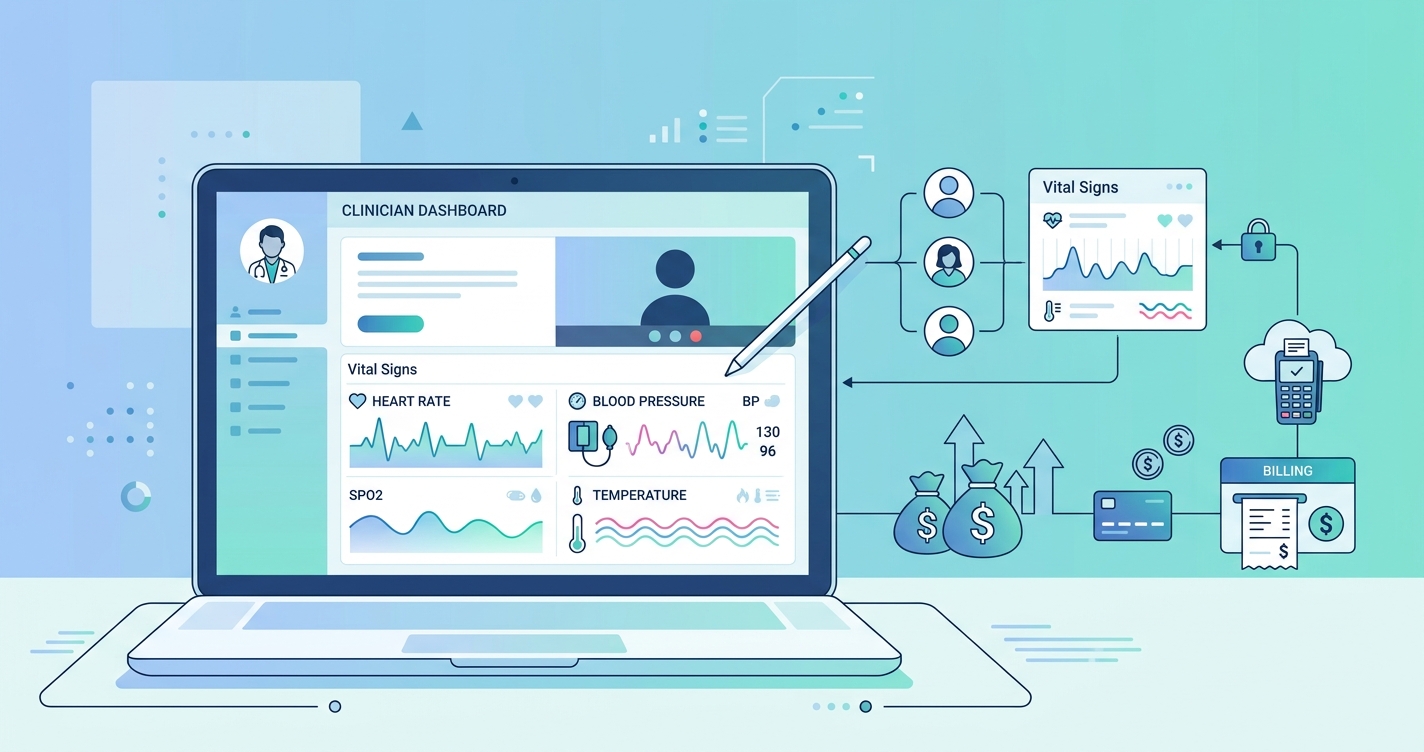
Telehealth monetize vitals features is no longer a speculative product question. It is now a revenue design question. Virtual care platforms used to sell video visits, scheduling, and messaging as a bundled convenience layer. That market got crowded fast. The platforms finding pricing power in 2026 are the ones adding clinical measurement, especially vital signs capture, then turning that capability into billable workflows, premium software tiers, and stronger enterprise contracts.
What matters is not just whether a platform can capture heart rate, respiratory rate, or blood pressure trends. The real issue is how that data changes the business model.
"Home telemonitoring significantly reduced hospitalizations, emergency department visits, and total hospital days at both 3 and 6 months." — Hui-Wen Po and colleagues, JMIR Formative Research, 2024
Why telehealth monetize vitals features has become a board-level topic
The economics of virtual care have shifted. Deloitte projected the U.S. virtual health market could approach $100 billion by 2025, but the same firm also noted a disconnect between consumer demand and what health systems are actually paid to deliver. In plain English: usage is there, but plain video visits do not always create durable margins.
That is why vital signs matter. Once a telehealth platform captures physiologic data, it starts to participate in clinical operations rather than just communication. CMS and the AMA have both moved to make remote patient monitoring easier to bill in 2026, including more flexible thresholds for transmitted data days. That change matters because reimbursement friction had been one of the biggest reasons RPM programs underperformed their early forecasts.
McKinsey has also argued that a large share of healthcare activity can move into virtual and home-based settings when the right measurement layer exists. Vitals are part of that layer. Without them, a telehealth platform is a meeting room. With them, it starts to look like infrastructure.
The four revenue models behind telehealth vital signs monetization
The strongest telehealth businesses usually do not rely on one monetization path. They stack several.
| Monetization model | Primary buyer | How revenue is generated | What makes vitals valuable | |---|---|---|---| | RPM-enabled reimbursement workflows | Health systems and medical groups | More reimbursable monitoring programs | Vitals create billable longitudinal data | | Premium platform tiers | Existing software customers | Higher subscription or seat pricing | Vitals move the product into a more clinical tier | | Enterprise expansion and renewals | Health systems, payers, virtual care providers | Bigger contracts and better renewal leverage | Embedded measurement makes switching harder | | New service lines | Specialty clinics, chronic care programs, virtual-first providers | New modules for triage, chronic care, and follow-up | Vitals support additional workflows beyond the visit |
Each model has different economics, but they all depend on the same idea: vital signs increase the clinical utility of the platform.
RPM reimbursement is usually the first monetization lever
For many telehealth platforms, the cleanest revenue story begins with RPM. CMS reimbursement for RPM remains one of the easiest ways to convert vitals capture into measurable financial value for provider customers. In 2026, the core code set still revolves around setup, data transmission, and treatment management time, but rule changes lowered the operational burden for many programs.
That matters because patient adherence has always been the weak link. The old 16-day threshold often turned revenue projections into fiction. Programs looked good in spreadsheets and then missed billing thresholds in the real world. Newer code flexibility makes twice-weekly or moderate-frequency monitoring more economically usable.
A platform does not usually bill those codes itself. Its customers do. But that distinction does not weaken the business case. It strengthens it. If a provider organization can generate reimbursement from workflows that run through the telehealth platform, the platform gains pricing power. It can justify implementation fees, premium modules, or revenue-share structures because the customer now has a direct path to ROI.
Premium pricing works when vitals change the workflow, not just the feature list
A lot of software companies make the same mistake here. They treat vitals as another checkbox on a pricing page. That rarely holds.
Vital signs support premium pricing when they change what a care team can actually do. A provider seeing heart rate trends before a medication review, or a nurse reviewing respiratory rate changes after discharge, is working differently than a clinician on a plain video call. The software is no longer just facilitating a visit. It is supporting clinical judgment across time.
This is where telehealth platforms can build high-value packaging:
- Premium chronic care modules
- Post-discharge follow-up programs
- Provider-facing dashboards with trend analysis
- Alerting and triage workflows tied to vital signs changes
- Documentation layers that support reimbursement and audit readiness
That packaging matters because enterprise buyers do not pay more for novelty. They pay more for a workflow they cannot easily recreate with generic video tools.
Expansion revenue often matters more than net-new sales
The hardest truth in telehealth software is that new logo growth gets expensive once the market matures. Expansion inside existing accounts becomes the better business.
Vitals features are unusually strong expansion tools because they can move a platform into new departments and use cases. A customer that first bought telehealth for primary care visits may later expand into chronic disease management, hospital-at-home follow-up, behavioral health screening, or specialty triage once vital signs become available.
That turns a single contract into a sequence of contract extensions.
Research backs the care impact piece. In a 2024 prospective cohort study, Hui-Wen Po and colleagues at National Taiwan University Hospital Yunlin Branch and the Industrial Technology Research Institute found that remote health monitoring reduced readmissions, emergency department visits, and hospital days among high-risk post-discharge patients. Separately, a 2025 Telemedicine and e-Health report from Michigan Medicine described a large-scale RPM program associated with a 59% reduction in hospital admissions among high-risk patients. Those figures help explain why enterprise buyers keep asking whether telehealth platforms can support more than a one-time visit.
A comparison of the main monetization paths
| Strategy | Time to value | Margin profile | Operational complexity | Best fit | |---|---|---|---|---| | RPM reimbursement support | Medium | High when adoption is stable | Moderate due to documentation and billing logic | Health systems and chronic care programs | | Premium software tier | Fast | Strong software margins | Low to moderate | SaaS telehealth vendors with installed base | | Usage-based vitals pricing | Fast | Variable | Low | Platforms with high visit volume | | Services-led deployment | Medium | Lower margin but sticky | High | Enterprise rollouts needing workflow design | | Outcome-linked contracts | Slow | Potentially high | High due to measurement burden | Mature platforms with strong analytics |
The table makes one thing obvious: there is no universal best model. But premium tiers plus reimbursement support is often the most practical combination. It gives customers a financial reason to adopt while giving the platform recurring software revenue.
Where telehealth platforms usually lose the revenue opportunity
Three mistakes show up again and again.
Treating vitals as a demo feature
A live scan in a sales meeting is compelling, but a demo does not equal monetization. If the product team does not build documentation, dashboarding, routing, and reporting around the signal, the feature stays impressive and economically useless.
Ignoring provider workflow economics
Clinicians will not pay attention to vitals data that lands in the wrong place, at the wrong time, with no context. Revenue follows workflow adoption. Workflow adoption follows relevance.
Building for one visit instead of longitudinal care
The best revenue from vital signs usually comes from repeated use, not one-off use. A platform that captures vitals once during a video visit is interesting. A platform that supports trending, follow-up, escalation, and reimbursement-ready monitoring is commercially stronger.
Industry applications for monetized telehealth vitals
Chronic care and longitudinal monitoring
This is the clearest fit. Programs in hypertension, heart failure, COPD, and diabetes benefit from recurring measurements and trend visibility.
Post-discharge programs
Hospitals need ways to spot deterioration early after discharge. Vitals data gives telehealth teams another signal before a readmission happens.
Virtual specialty care
Cardiology, pulmonary, and high-risk primary care workflows gain more value from vital signs than generic video visits do.
Employer and payer-sponsored navigation
Payers and self-insured employers increasingly want measurable engagement and triage, not just access. Vitals can help support that shift.
Current research and evidence
The evidence base here is still uneven, but the signal is strong enough to matter commercially.
Hui-Wen Po's 2024 JMIR Formative Research study showed lower readmissions and emergency department use in a high-risk post-discharge population using remote monitoring. Michigan Medicine's 2025 Telemedicine and e-Health findings pointed in the same direction at larger scale, reporting a 59% drop in hospital admissions for high-risk RPM participants. On the policy side, 2026 CMS and AMA updates made remote monitoring codes easier to use in less rigid monitoring schedules, which directly improves the monetization case for telehealth platforms trying to support provider reimbursement.
I would not oversell this as a guaranteed margin machine. Programs still fail when adoption is weak or workflows are sloppy. But the market has clearly moved past the stage where vitals are just a flashy add-on.
The future of telehealth vital signs monetization
The next phase is not just more measurements. It is tighter packaging.
Platforms will keep bundling vitals with triage, clinical decision support, asynchronous follow-up, and reimbursement logic. That is where the defensibility comes from. Buyers want fewer disconnected vendors. They want one platform that can host the visit, capture the signal, route the data, and support the business model around it.
That is also why embedded measurement matters strategically. Once vital signs become part of the provider interface and the reporting layer, they influence both care delivery and contract value. That is much harder to swap out than a video vendor.
Frequently asked questions
How do telehealth platforms monetize vital signs features in practice?
Most do it through a mix of premium subscription tiers, RPM-supporting workflows for providers, implementation fees, and account expansion into chronic care or post-discharge programs.
Do telehealth platforms bill RPM codes directly?
Usually no. Provider organizations bill the RPM codes. The telehealth platform monetizes by charging for the software, workflow support, and clinical infrastructure that make those programs viable.
What is the fastest way to create revenue from telehealth vitals?
Premium packaging inside an existing customer base is usually fastest. It is simpler to upsell a current account than to build a new services business from scratch.
Why are vital signs features more valuable than ordinary telehealth add-ons?
Because they can affect reimbursement, workflow, and contract stickiness at the same time. Most add-ons only improve one of those.
If you're evaluating how to package camera-based vital signs inside a virtual care product, it helps to study how platforms are already structuring reimbursement, infrastructure, and rollout strategy. You can also explore how solutions like Circadify support embedded telehealth measurement workflows. For more context on this microsite, see our analyses on how telehealth companies build a vitals integration business case and how RPM reimbursement codes apply to telehealth vitals capture.