How Can My Doctor Watch My Blood Pressure From My Couch?
Discover how contactless technology allows clinicians to monitor blood pressure from home video visits, transforming hypertension management for telehealth platforms.
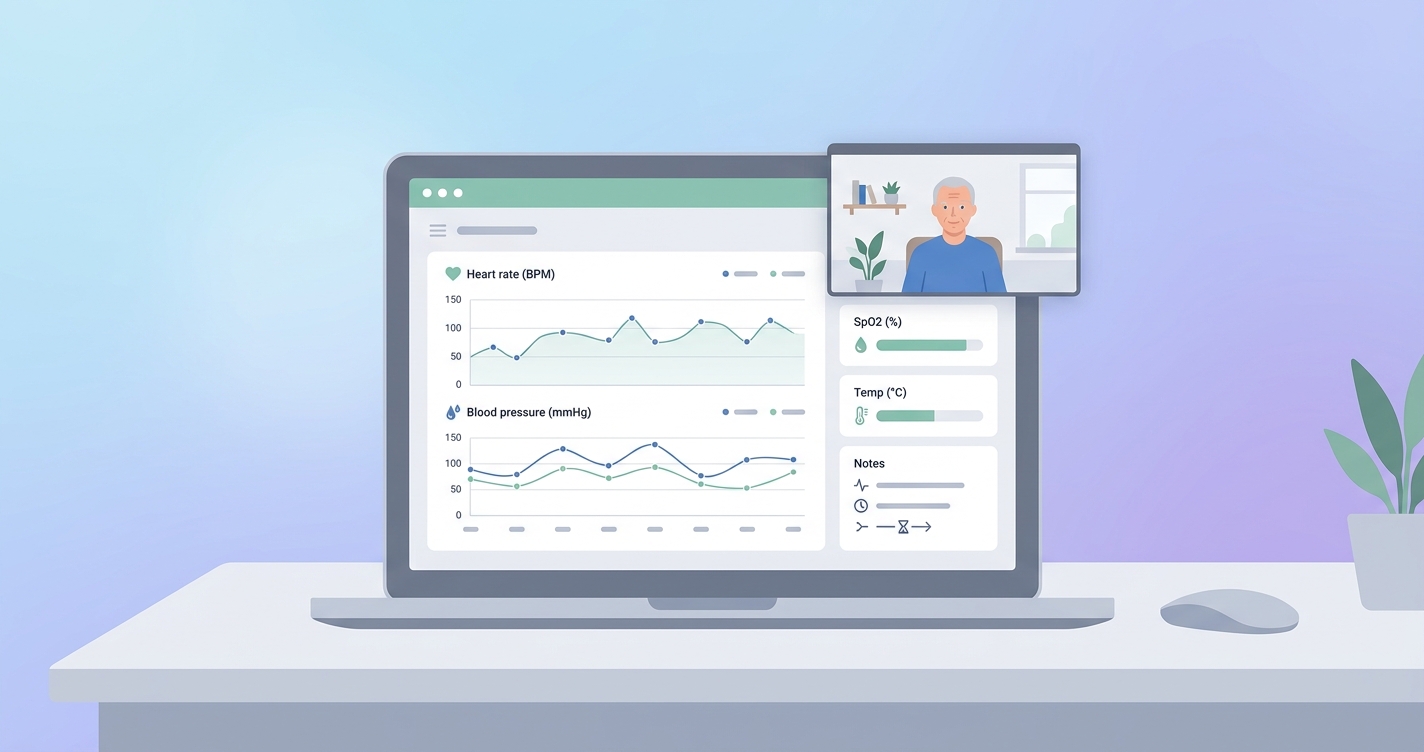
The management of hypertension is a global health challenge defined by a paradox: while blood pressure is a simple measurement, consistent and effective monitoring is notoriously difficult. For patients, the routine of using a cuff-based device is cumbersome, leading to infrequent readings that miss the fluctuations of daily life. For providers, these sporadic data points offer an incomplete picture for making informed clinical decisions. This gap between the need for continuous data and the reality of episodic measurement has left clinicians and patients searching for a better, more integrated approach to care.
"Hypertension is a major risk factor for heart disease and stroke. Only about half of adults with high blood pressure have it under control."
- Centers for Disease Control and Prevention (CDC)
The rise of contactless blood pressure monitoring
The fundamental limitation of traditional blood pressure monitoring is the reliance on physical hardware. The inflatable cuff, while a clinical standard for diagnostic readings, is impractical for the high-frequency data collection needed for effective chronic care management. A new generation of technology is emerging to address this challenge, making it possible for a provider to monitor blood pressure from home video visit without any specialized patient-side hardware. This technology is known as remote photoplethysmography (rPPG).
Instead of pressure, rPPG uses light. The core science, sometimes called transdermal optical imaging, relies on a standard video camera to detect minute, imperceptible changes in the color of human skin. These changes are caused by the pressure wave of blood moving through the capillaries just below the surface. Advanced signal processing algorithms analyze the video feed of a patient's face to translate these optical signals into vital signs, including pulse rate, respiratory rate, and trends in blood pressure. The entire process happens in the background of a standard telehealth video call, requiring no action from the patient beyond being visible on camera.
Comparing blood pressure monitoring methods
The introduction of video-based monitoring creates a new paradigm for telehealth platforms. It is not a replacement for diagnostic cuff measurements but a complementary tool for longitudinal trend analysis.
| Feature | Traditional Cuff-Based Monitoring | Contactless Video-Based Monitoring (rPPG) | | :--- | :--- | :--- | | Patient Hardware | External blood pressure cuff required | None; uses patient's existing device camera (smartphone, laptop) | | Patient Experience | Can be uncomfortable; requires active participation | Passive and frictionless; no action required during video visit | | Data Frequency | Episodic; typically once or twice daily | High-frequency; can be captured during every telehealth encounter | | Primary Use Case | Diagnostic measurement and calibration | Longitudinal trend analysis and risk stratification | | Workflow Integration| Manual patient reporting or separate device integration | Integrated directly into the telehealth video stream via SDK |
Industry applications for telehealth platforms
For telehealth and remote care software companies, the integration of contactless vitals is a significant differentiator. It moves the platform beyond simple video conferencing into a sophisticated clinical data collection tool.
Chronic care management (ccm)
- Passively collect blood pressure trends during routine monthly check-ins.
- Use trend data to identify patients whose condition may be worsening.
- Automate the collection of vital signs data required for reimbursement.
Remote patient monitoring (rpm)
- Augment data from patient-provided cuff readings with high-frequency video-based trends.
- Reduce the operational overhead of shipping and managing hardware for lower-risk patient segments.
- Provide a more complete data set to care teams for proactive intervention.
Virtual urgent care
- Capture baseline vital signs trends during initial patient triage.
- Help clinicians stratify risk and determine if an in-person visit is necessary.
- Add a layer of objective data to subjective patient-reported symptoms.
Current research and evidence
The field of contactless blood pressure monitoring has seen a rapid expansion of research validating its potential. While not yet a replacement for oscillometric cuffs for diagnosis, its accuracy for trend monitoring is well-documented.
A 2020 study by Wang et al. published in PubMed detailed a non-contact method based on face video, demonstrating the viability of extracting blood pressure estimations from the subtle color variations in facial skin. Further research has built on this foundation. A team at the University of Toronto led by Kang Lee and published in the American Heart Association journal Circulation, explored what they term "transdermal optical imaging," successfully measuring blood pressure using smartphone cameras.
More recently, a study from the Russian Society of Cardiology by Korolev et al. (2022) focused on using artificial intelligence with standard webcams. Their work highlighted that machine learning models could achieve accuracy levels for systolic and diastolic pressure that fall within the standards set by organizations like the British Hypertension Society (BHS) for certain applications. The collective findings from these and other studies indicate that while the technology is still evolving, it provides a robust method for tracking blood pressure trends over time.
The future of remote blood pressure monitoring
The trajectory of contactless vitals technology points toward a future of truly passive and ubiquitous monitoring. As signal processing algorithms and machine learning models become more sophisticated, the accuracy and reliability of video-based measurements will continue to improve. This opens the door to scenarios where vital signs can be monitored continuously and ambiently, not just during a video call but whenever a patient is in front of a camera-enabled device. For telehealth platforms, this technology represents a foundational shift, enabling a move from reactive, patient-initiated care to proactive, data-driven health management. The ability to seamlessly gather longitudinal data will unlock new possibilities for AI-driven triage, risk prediction, and personalized digital interventions.
Frequently asked questions
Q: Is video-based blood pressure monitoring accurate enough for clinical use? A: This technology is designed for monitoring blood pressure trends over time, not for providing a one-time diagnostic reading. It is highly effective for identifying changes and patterns between traditional cuff measurements. It should be used as a complementary data source to, not a replacement for, cuff-based devices.
Q: How does this technology integrate into an existing telehealth platform? A: Contactless monitoring is typically integrated via a software development kit (SDK). The SDK handles the complex signal processing on the device, providing a simple API for the telehealth application to start, stop, and receive vital signs data during a video session. This allows platform providers to add the capability without deep expertise in signal processing.
Q: What are the privacy and security considerations? A: Leading rPPG solutions prioritize privacy by processing the video stream directly on the end-user's device (on-device processing). This means the video itself is never transmitted to the cloud for analysis, and only the resulting numerical vital signs data is sent to the provider. This architecture is essential for maintaining HIPAA compliance and patient trust.
The ability to monitor blood pressure trends during a video call is no longer a futuristic concept. For telehealth platforms looking to deepen their clinical capabilities and differentiate their offerings, the time to investigate this technology is now. Circadify is at the forefront of this space, providing a robust SDK that enables the integration of contactless vitals into any virtual care workflow. To learn more about adding these capabilities to your platform, explore our custom build options and developer documentation at circadify.com/custom-builds.