FHIR Vital Signs Resources: Developer Guide for Telehealth
A practical analysis of FHIR vital signs developer telehealth architecture, profiles, subscriptions, and implementation choices for virtual care teams.
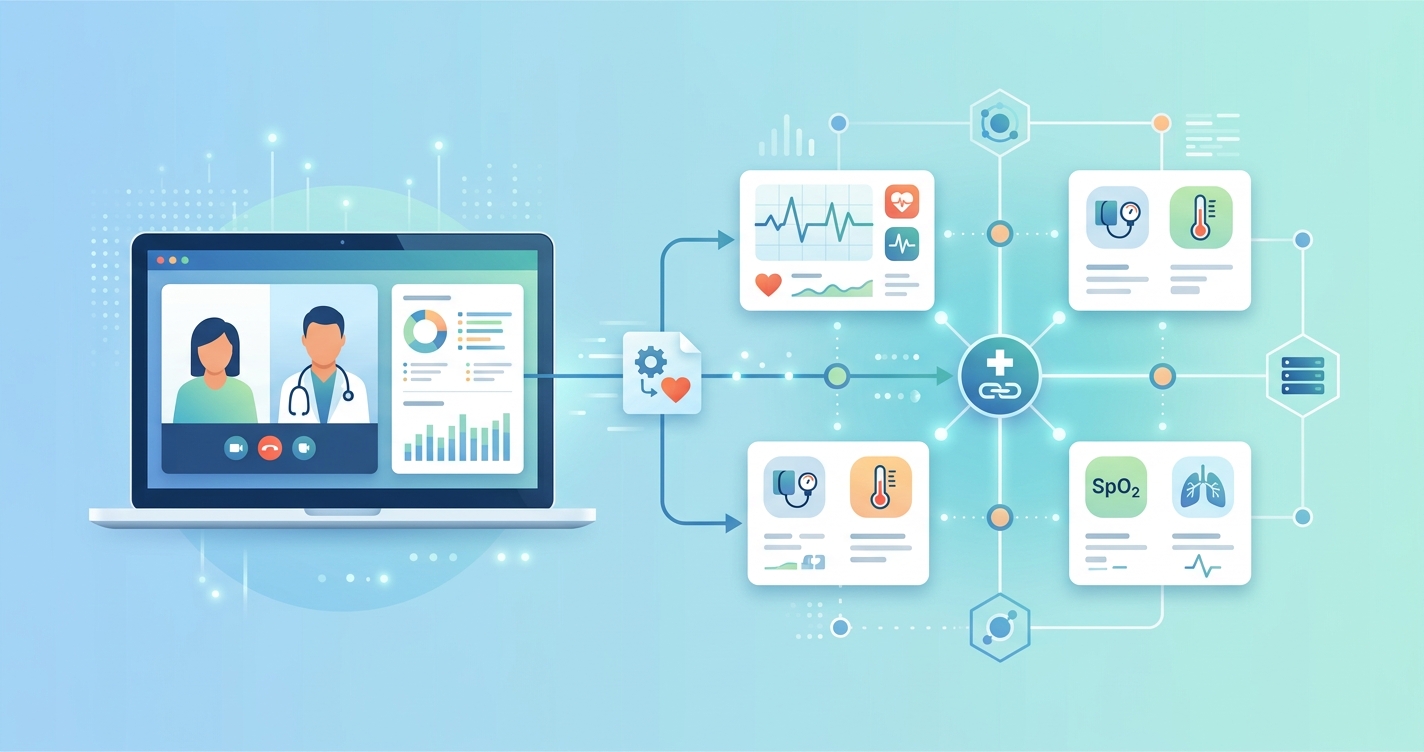
FHIR vital signs developer telehealth work usually looks simple from a distance. Developers hear “just map the vitals into FHIR” and assume the hard part is done once an Observation resource exists. It usually is not. In real telehealth systems, the messy questions start right after that: which profile to follow, how to represent qualifying context, whether to push one measurement or a panel, how to support event-driven updates, and how to keep all of it usable for clinicians rather than merely valid in a conformance test.
“Vital signs will be one of the first areas where there is a need for a single, global vocabulary to allow for ubiquitous access and re-use.” — HL7 FHIR R5, Observation Vital Signs Panel Profile
Why FHIR vital signs resources matter in telehealth architecture
HL7’s FHIR specification puts vital signs inside the Observation resource, and the base vital signs profile sets the minimum shape: status, category, code, patient, time, and a numeric value with UCUM units when a numeric result exists. That sounds basic, but telehealth teams quickly run into higher-stakes design choices because virtual care depends on context as much as raw measurement.
A heart rate taken during a live video visit, a respiratory rate captured asynchronously at home, and a blood pressure measurement sent by a connected cuff may all look similar at the API layer. Clinically, they are not the same thing. That is why the profile choice matters.
The official HL7 R5 vital signs guidance and the US Core Vital Signs Profile both push implementers toward standardized coding, especially LOINC for what was measured and UCUM for units. That consistency is what makes downstream search, retrieval, CDS rules, dashboards, and EHR exchange less brittle.
| FHIR resource or guide | What it does | Why telehealth teams care |
|---|---|---|
| Base Observation vital signs profile | Defines the minimum structure for core vital sign observations | Creates a common payload shape across apps and systems |
| US Core Vital Signs Profile | Adds US-specific interoperability expectations | Important for patient apps, provider platforms, and EHR exchange in the US |
| Vital Signs with Qualifying Elements IG | Adds contextual elements like body position, laterality, cuff size, and device type | Useful when telehealth measurements need more clinical interpretation |
| Subscriptions R5 Backport IG | Brings event-driven notifications to R4/R4B environments | Useful for alerting, triage, and real-time monitoring flows |
That table gets at the real issue: most telehealth platforms do not need “FHIR” in the abstract. They need the right subset of FHIR resources and implementation guides for the workflow they are building.
The FHIR Observation resource is the center of gravity
If you strip away the acronyms, the core model is straightforward. FHIR expects vital signs to be represented as observations about a patient at a point in time.
The HL7 vital signs profile says each observation should include:
- A
status - A category of
vital-signs - A code that says what was measured
- A patient reference
- An effective time
- A numeric result value and standard UCUM unit, unless a reason for missing data is provided
That structure matters because it keeps telehealth data useful outside the app that created it. Developers often focus on getting measurements into storage. Interoperability starts when another system can query the same data without custom translation work.
US Core raises the bar a bit further for US-facing products. Its guidance is not just about payload validity. It is about making vital signs exchange predictable for patient-facing apps, provider systems, and EHR-connected workflows. If a telehealth vendor wants clean downstream interoperability, this is usually the baseline rather than an optional enhancement.
Where telehealth teams get stuck
The recurring problems are surprisingly ordinary.
Panel versus individual observations
Blood pressure is the classic example. Teams want one clean object. Clinical interoperability often wants a panel plus component values. If you flatten everything for convenience, you make later exchange harder.
Missing context
Some vital signs are only clinically useful when the system also captures how the reading was taken. The HL7 Vital Signs with Qualifying Elements guide exists for a reason. Body position, cuff size, laterality, location, and device type can change interpretation.
Real-time delivery expectations
A telehealth platform may need to show data during the visit, trigger post-visit escalation, or send later updates into the record. Those are three different delivery models. The resource shape alone does not solve that.
Version mismatch
A lot of production healthcare software still runs on FHIR R4. Newer event-driven patterns keep moving toward R5 concepts. The Subscriptions R5 Backport guide matters because it gives teams a more practical bridge instead of forcing a full version jump all at once.
Industry applications for FHIR vital signs in telehealth
Live video visits
During synchronous virtual care, vital signs resources need low-latency creation and predictable rendering. The measurement is only valuable if it reaches the clinician in time to shape the conversation.
Remote patient monitoring
RPM programs care less about one-off display and more about longitudinal consistency. That means better patient matching, stable coding, event-driven updates, and trend retrieval over time.
Triage and escalation workflows
Here, the interesting part is not just the reading. It is what happens next. Topic-based subscriptions and event-driven observation pipelines become much more important when a platform needs alerts, routing, or nurse review queues.
Cross-system exchange
Hospital systems, virtual care vendors, and device ecosystems rarely share the same stack. The 2025 scoping review in Frontiers in Digital Health found HL7 FHIR, ISO/IEEE 11073, and IHE profiles across telemonitoring literature, but it also concluded that harmonization remains a major barrier. That finding feels familiar to anyone who has actually shipped these integrations.
Current research and evidence
A useful anchor here comes from HL7’s own specification. The R5 vital signs guidance argues for a single global vocabulary and common syntax so measurements from patient wearables, apps, and provider systems can be reused rather than trapped in product silos.
The US Core Implementation Guide builds on that by specifying how vital signs should be written and exchanged in the US context. For telehealth developers, that matters because it narrows ambiguity. Less ambiguity usually means fewer brittle integrations later.
The broader interoperability picture is less tidy. In the 2025 scoping review “Interoperability of telemonitoring data in digital health solutions,” the authors found that FHIR is one of the major standards in the literature, but they also noted persistent gaps around operational deployment and cross-border interoperability. That is a polite academic way of saying the standards story is improving faster than the implementation reality.
Another practical study comes from JMIR Medical Informatics. In “Fast Healthcare Interoperability Resources for Inpatient Deterioration Detection With Time-Series Vital Signs: Design and Implementation Study,” researchers showed how systolic blood pressure, diastolic blood pressure, heart rate, respiratory rate, and temperature could be converted into FHIR observations and used in deterioration detection pipelines. The setting was inpatient care, not telehealth, but the lesson translates well: once vital signs are normalized into a standard model, alerting and analytics become easier to scale.
Event-driven exchange is another piece of the puzzle. The HL7 Subscriptions R5 Backport guide reflects a broader shift away from static query-only patterns and toward topic-based notifications. For telehealth teams building escalation logic or near-real-time monitoring, that shift matters more than another abstract interoperability slide deck.
What a solid telehealth implementation usually includes
A practical implementation tends to share a few traits:
- Base conformance to the FHIR
Observationvital signs pattern - US Core support when US interoperability is in scope
- Qualifying elements for measurements that need more context
- Event-driven delivery for alerting or longitudinal monitoring
- Clear handling of provenance, device metadata, and encounter context
Developers sometimes want a single canonical payload that covers every use case. I get the temptation. It almost never lasts. Telehealth platforms do better when they define a small number of reliable patterns tied to real workflows instead of chasing one universal object.
The future of FHIR vital signs resources in telehealth
The direction of travel is pretty clear even if the market is still uneven.
Telehealth software is moving from document exchange toward event-driven interoperability. That means subscriptions, notification bundles, better device context, and cleaner support for continuous measurement streams. It also means developers will spend less time arguing about whether FHIR is relevant and more time arguing about which implementation guide, profile, or subscription model best fits the product.
I would expect three things over the next cycle.
First, more telehealth vendors will treat vital signs as part of their core data model rather than as a bolt-on widget. Second, qualifying elements will matter more because remote measurement quality lives or dies on context. Third, hybrid architectures will keep winning: local capture for speed, cloud coordination for storage, routing, and downstream exchange.
That pattern lines up with what we have seen across this microsite in pieces like how to add vital signs to your telehealth platform and multi-tenant vitals architecture for telehealth SaaS platforms. The payload is only one part of the system. The architecture around it decides whether it becomes useful.
Frequently Asked Questions
What FHIR resource is used for telehealth vital signs?
The primary resource is Observation. HL7’s vital signs profile defines the minimum structure for representing measurements like heart rate, respiratory rate, body temperature, blood pressure, and oxygen saturation.
Why does US Core matter for telehealth developers?
US Core reduces ambiguity for US interoperability. It gives clearer expectations for coding, units, and exchange patterns across patient apps, provider systems, and EHR-connected workflows.
When should developers use qualifying elements for vital signs?
Use them when context changes interpretation. Blood pressure is the obvious example because body position, cuff size, and device details may affect clinical meaning and downstream usability.
Do telehealth platforms need FHIR subscriptions for vital signs?
Not always, but subscriptions become important when the platform needs event-driven alerts, escalation workflows, or near-real-time monitoring instead of simple pull-based retrieval.
Telehealth teams trying to productize vital signs usually discover the same thing: valid data is not the same as usable data. Solutions like Circadify are being built around that reality, helping platforms capture camera-based measurements and fit them into broader virtual care workflows without forcing every integration team to invent the model from scratch.