How Can My Grandma Get Her Heart Rate Checked Without a Device?
How elderly telehealth heart rate capture works without wearables or cuffs, and why contactless camera-based vitals matter for an aging patient population.
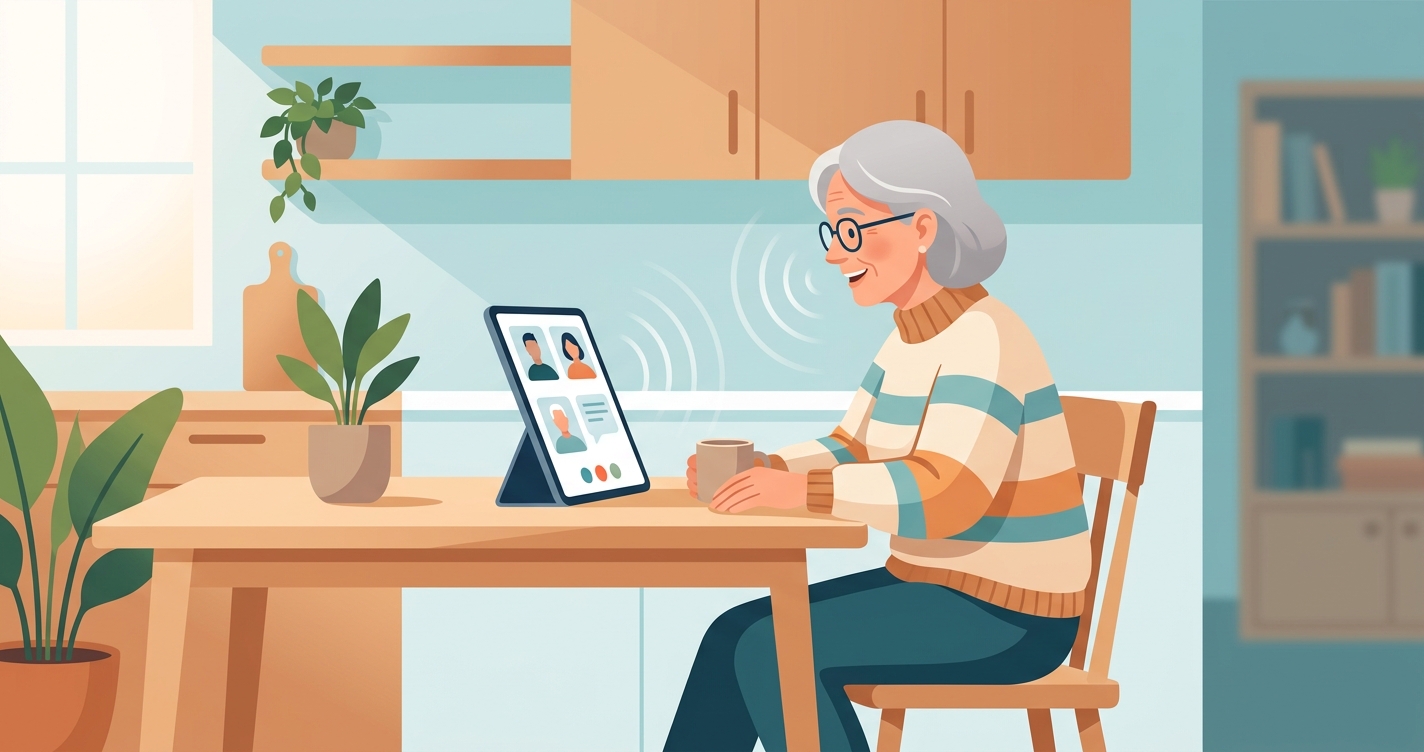
A common question lands in family group chats and clinic inboxes alike: how can an older relative get her heart rate checked without buying, charging, pairing, and wearing yet another gadget? It is a fair question, and it points at a real gap in virtual care. The answer increasingly involves elderly telehealth heart rate capture that happens through the camera the patient is already looking into during a video visit, with no cuff, no chest strap, and no app to configure. For telemedicine software vendors, this shift from hardware-dependent monitoring to frictionless, camera-based measurement is one of the more consequential design decisions facing the aging-care market.
The reason this matters is demographic before it is technical. Older adults are the heaviest users of healthcare and the most poorly served by device-based remote monitoring. Every step that requires manual setup is a step where measurement quietly fails to happen.
A 2024 mediation analysis of US national data published in JMIR found that wearable device adoption among older adults remains constrained by usability barriers, technology anxiety, and cost, even as the same population stands to gain the most from continuous vital sign visibility.
Why elderly telehealth heart rate capture breaks down with devices
The standard remote patient monitoring playbook assumes a patient who can unbox a device, connect it to Wi-Fi or Bluetooth, keep it charged, and remember to use it. For a meaningful share of older adults, each of those assumptions is a point of failure. Researchers studying digital health adoption through the lens of Innovation Resistance Theory (a 2024 scoping review summarized in PMC) grouped the obstacles into functional barriers like complex interfaces and age-related impairments, and psychological barriers like distrust of technology and low self-efficacy. A blood pressure cuff that pairs incorrectly or a wrist tracker that dies overnight does not just produce a missing data point. It produces a patient who concludes the whole system is not for them.
Contactless measurement removes the unboxing problem entirely. Remote photoplethysmography, or rPPG, reads the tiny color changes in facial skin caused by blood flow with each heartbeat. The camera in a phone, tablet, or laptop becomes the sensor. There is nothing to wear, nothing to charge, and nothing to pair. For a grandmother who already knows how to answer a video call, the measurement can happen inside the call she is already on.
Here is how the common options compare for an older patient and the platform serving them.
| Approach | Patient setup burden | Hardware cost | Works during a video visit | Suited to older adults | | --- | --- | --- | --- | --- | | Manual pulse check (fingers on wrist) | Low but error-prone | None | Only if patient self-reports | Limited by dexterity and counting accuracy | | Bluetooth pulse oximeter or cuff | Pairing, charging, app | Moderate | Requires separate step | Often abandoned after setup friction | | Wrist wearable | Charging, syncing, daily wear | Higher | Background only, not on demand | Adoption gap well documented | | Contactless rPPG via camera | None beyond joining the call | None (uses existing device) | Yes, captured live | Strong fit, no wearable required |
The pattern is consistent. The methods that demand the least from the patient are the ones most likely to produce a measurement at all.
- No additional purchase decision for the patient or family.
- No charging routine that fails the moment it is needed.
- No pairing or firmware step that triggers a support call.
- Measurement folded into an existing behavior rather than added on top of it.
- A path for caregivers to observe results without operating a separate device.
Industry applications for an aging patient population
Routine follow-up and medication checks
Most older-adult video visits are follow-ups: a blood pressure medication adjustment, a check after a cardiac event, a quarterly chronic-condition review. A clinician working without objective vitals is reasoning from self-report alone. Camera-based heart rate gives the provider a number captured in the moment, without asking the patient to do anything they would not already do. For platforms, this turns a routine visit into a richer clinical encounter without lengthening it.
Caregiver-assisted visits
Many older patients attend telehealth visits with an adult child or aide nearby. When vitals require a device, the caregiver becomes unpaid technical support. Contactless capture lets the caregiver focus on the conversation and the patient rather than troubleshooting a gadget. The measurement is invisible infrastructure, which is exactly what it should be.
Skilled nursing and assisted living
Facilities running group telehealth often cannot deploy a personal wearable to every resident. A shared tablet that can read heart rate from the face supports many residents without the inventory, cleaning, and charging logistics of per-patient hardware. The same workflow that serves one grandmother at home scales to a floor of residents.
Current research and evidence
The clinical case for contactless heart rate in older populations has strengthened recently. A clinical validation study of rPPG-enabled contactless pulse rate monitoring software, published in PMC and including participants spanning ages 44 to 80, reported a mean absolute error of roughly 1.06 bpm against ECG with a Pearson correlation of 0.962. That age range is precisely the cohort this question is about, which matters because aging skin, lower perfusion, and arrhythmia history are real variables.
Other 2023 to 2024 work fills in the nuances. A multimodal study in MDPI combining facial video with attributes like age and BMI achieved a mean absolute error near 3 bpm and a mean absolute percentage error around 4.2 percent, suggesting that incorporating patient characteristics improves robustness. At the same time, researchers have been candid about limits. An arXiv evaluation of rPPG in challenging conditions documented accuracy drops from video compression artifacts, low light, and motion, and a separate line of work noted that error rises at elevated heart rates. For an older population often sitting still in modest indoor lighting, the typical conditions are favorable, but vendors should treat lighting guidance and signal-quality feedback as first-class product requirements, not afterthoughts.
The adoption literature reinforces why the contactless route is worth the engineering. The same JMIR mediation analysis that flagged wearable barriers also found that easing the technology burden meaningfully raises telehealth engagement among older adults. Removing the device removes the barrier the research keeps identifying.
The future of contactless vitals for older adults
The direction of travel is toward measurement that disappears into the visit. Three developments are worth watching for teams building in this space.
- Expansion beyond heart rate. The same camera signal is being extended toward respiratory rate, heart rate variability, and blood pressure trend estimation, which would let a single video frame carry several vitals relevant to older patients.
- Signal-quality coaching built for low digital literacy. Expect interfaces that gently guide an older patient into frame and good lighting using plain visual cues rather than technical instructions.
- Tighter integration with care workflows. As reimbursement pathways for remote monitoring mature, contactless capture that flows directly into clinical records and trend dashboards will matter more than any single reading.
None of this requires the patient to learn anything new. That is the point, and it is the property that makes contactless capture uniquely suited to an aging demographic that the device-centric model has repeatedly left behind.
Frequently asked questions
Can a phone or tablet camera really measure heart rate without contact?
Yes. Remote photoplethysmography detects subtle color changes in facial skin tied to each heartbeat. Validation work including patients up to age 80 has reported close agreement with ECG under reasonable conditions, though good lighting and a still, well-framed face improve reliability.
Does my grandmother need to install or set up anything?
No additional setup beyond joining the video visit she would attend anyway. There is no device to pair, charge, or wear, which is what makes the approach a good fit for older adults who struggle with hardware-based monitoring.
Is camera-based heart rate as reliable as a cuff or finger device?
Under typical indoor, seated conditions it performs well, but accuracy can decline with poor lighting, motion, or very high heart rates. It is best understood as a frictionless way to capture trends during a visit, complementing rather than replacing dedicated clinical devices when a precise standalone reading is required.
Why would a telehealth platform choose contactless over sending patients a wearable?
Because the research consistently shows older adults abandon device-based monitoring due to setup, charging, and usability friction. Contactless capture removes those barriers, raising the odds a measurement actually happens during the visit.
Circadify is addressing this space directly, building a contactless rPPG SDK that adds real-time vital signs to telehealth platforms without asking patients to own or operate any hardware. Telehealth and telemedicine teams evaluating frictionless vitals for an aging patient population can review the platform demo and SDK documentation at circadify.com/custom-builds.