Why Can't My Grandparents Get Their Heart Health Checked From Home After Age 70?
Older adults struggle to capture heart vitals at home. How telehealth platform vitals and contactless rPPG can close the gap for seniors over 70.
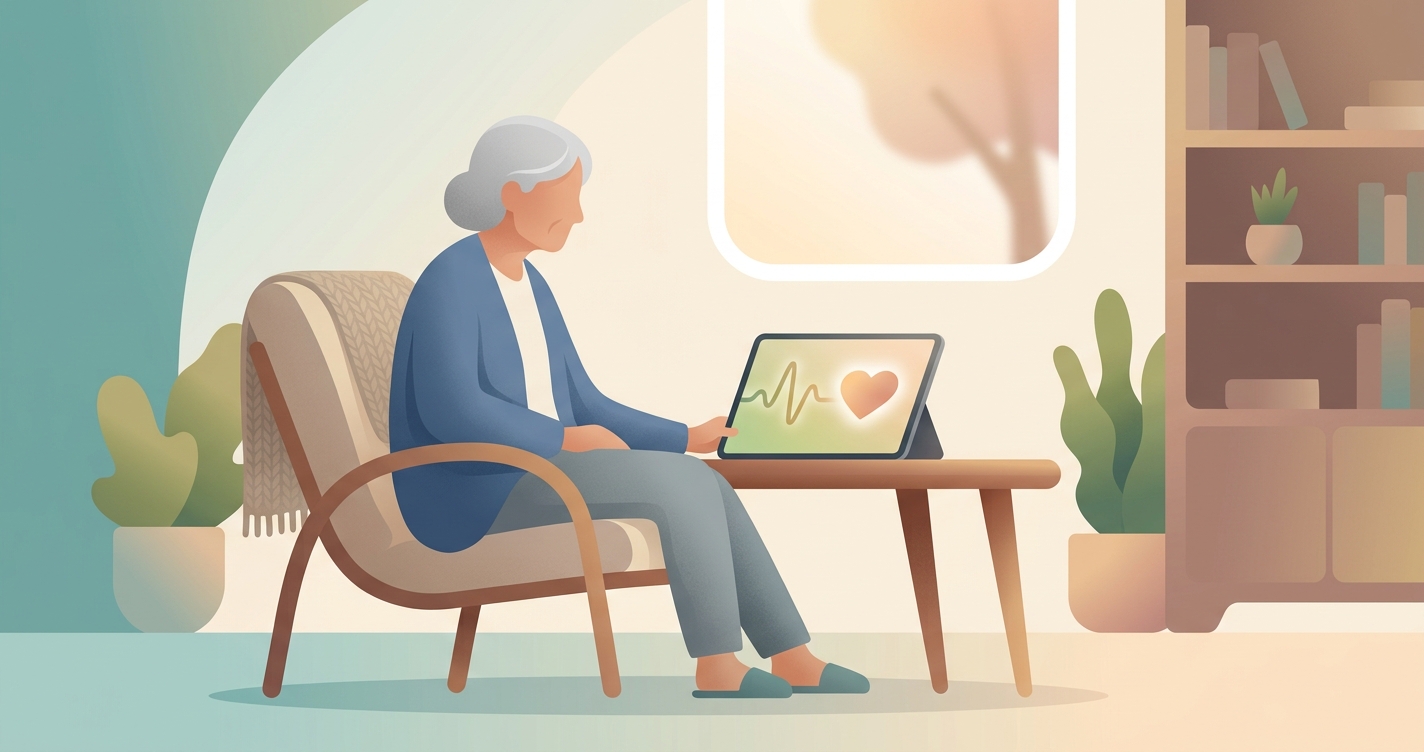
A family video call with an 82-year-old often ends the same way it began: with a heart concern that nobody could actually measure. The grandparent describes a flutter, a dizzy spell, or a racing pulse, and the clinician on the other end of the screen has no reliable way to confirm what is happening in the moment. The reason is rarely the technology of video itself. It is that telehealth platform vitals capture, for the population that needs it most, still assumes a level of device handling, dexterity, and digital fluency that many adults over 70 do not have. Heart health monitoring at home was supposed to be the easy part of aging in place. For a large share of seniors, it remains the missing piece.
Approximately 50% of patients with cardiovascular disease used telehealth in the past year, and 74 to 85% reported satisfaction with the quality of those visits, yet most virtual cardiac encounters still occur without a single objective vital sign captured during the call. (American Heart Association, 2024)
The real barrier behind telehealth platform vitals for seniors
The assumption baked into most remote monitoring programs is that a patient will buy a device, charge it, pair it over Bluetooth, hold it correctly, read a small display, and report the number accurately. Each of those steps is a failure point for an older adult, and they compound. A 2024 scientific statement from the American Heart Association on telehealth and health equity in older adults with heart failure identified device usability, visual and cognitive limitations, and lack of hands-on training as primary drivers of disengagement. The result is a documented paradox. Seniors with heart conditions are highly willing to use virtual care, but the tools meant to make that care clinically meaningful are the ones they abandon first.
For telehealth platform companies, this is not a peripheral edge case. Adults over 70 are the highest utilizers of cardiovascular care and among the heaviest users of Medicare-reimbursed telehealth. A platform that cannot capture telehealth platform vitals from this group is, in practice, a platform that delivers video conversations rather than clinical assessments to its single most valuable patient segment.
The barriers cluster into a few predictable categories:
- Hardware friction: charging, pairing, replacing batteries, and storing multiple single-purpose devices.
- Sensory limits: small screens, low-contrast displays, and quiet audio cues that visually or hearing-impaired seniors miss.
- Cognitive load: multi-step workflows that must be remembered and repeated daily.
- Skin and physical fragility: finger clips and cuffs that are uncomfortable or difficult to position with arthritic hands.
- Data handoff: manually reading and reporting numbers, which introduces transcription error.
Comparing how seniors capture heart vitals at home
The choice of measurement method largely determines whether an older patient will actually produce usable data. The table below compares the common approaches against the realities of a patient over 70.
| Capture method | Setup burden for senior | Hardware needed | Failure points | Fit for video visit | |---|---|---|---|---| | Manual pulse count | High (timing, counting) | None | Miscounting, missed arrhythmia | Poor | | Bluetooth pulse oximeter | Medium to high | Dedicated device + charging | Pairing, finger placement, battery | Moderate | | Cuff blood pressure monitor | High | Cuff + power | Positioning, arm support, reading | Moderate | | Wearable smartwatch | High (ongoing) | Watch + charging + phone app | Charging discipline, tiny UI, updates | Moderate | | Contactless rPPG via camera | Low | Existing phone, tablet, or laptop | Lighting, brief stillness | Strong |
Remote photoplethysmography, or rPPG, stands out because it removes the hardware step entirely. The patient does not buy, charge, pair, or hold anything. They look at the same camera they already use for the video visit, and the platform extracts heart rate and related signals from subtle color changes in facial skin. For a population defined by hardware abandonment, eliminating the hardware is not a feature. It is the unlock.
Industry applications for aging populations
Routine cardiac follow-up
Most post-discharge and chronic heart failure follow-ups are conducted to check trend, not to perform a procedure. A clinician wants to know whether resting heart rate has crept up, whether the patient looks more breathless, and whether anything has changed since last week. When telehealth platform vitals are captured passively during the call, the clinician gets that trend without asking an 80-year-old to fumble with a clip mid-conversation.
Medication Titration
Beta blockers and rate-control medications require pulse monitoring. Asking a senior to self-measure daily and log numbers produces sparse, error-prone records. Camera-based capture during scheduled check-ins gives prescribers a consistent, time-stamped data point tied to a real clinical interaction.
Caregiver-Mediated Visits
Adult children frequently join their parents' video visits. A platform that captures vitals through the camera lets the family member focus on the conversation rather than acting as an improvised medical technician operating an unfamiliar device.
Current research and evidence
The evidence base for contactless cardiac measurement in older adults has matured considerably. Researchers at CNR-IRIS in Italy specifically evaluated camera-based photoplethysmography for vital sign estimation in elderly subjects, addressing the population that most device-based studies exclude. Their work is notable because aging skin, reduced perfusion, and movement patterns differ from the young, healthy volunteers who dominate earlier rPPG datasets.
Broader validation continues to strengthen. A 2024 prospective comparative study published through PMC examined rPPG-enabled contactless pulse rate monitoring software in cardiovascular disease patients, a more clinically representative group than wellness-app cohorts. Systematic reviews of non-contact vision-based monitoring, including a 2024 review in MDPI Sensors, report strong agreement for heart rate and respiratory rate, with mean absolute error for heart rate reported as low as roughly 3 beats per minute in favorable conditions. The same reviews are candid about limits: blood pressure estimation remains more moderate, and accuracy across diverse skin tones and lighting conditions still demands careful engineering and larger datasets.
For platform builders, the research points to a clear near-term scope. Heart rate, heart rate variability, and respiratory rate are well supported for trend monitoring in the home. These happen to be exactly the signals most relevant to routine cardiac follow-up in seniors. The honest framing is that camera-based vitals are a screening and trending layer, not a replacement for diagnostic-grade in-clinic equipment, and that distinction should be designed into the product rather than glossed over.
The future of at-home senior heart monitoring
The direction of travel is toward measurement that disappears into the interaction. The global remote patient monitoring market reached an estimated $22 billion in 2024, and the segment growing fastest is the one that reduces patient effort to near zero. For seniors, the winning design is not a better device but the absence of one.
Three shifts are likely to define the next few years:
- Passive capture as default: vitals collected automatically during any video encounter, with no separate measurement step.
- Reimbursement alignment: remote monitoring codes increasingly recognizing software-captured vitals, improving the business case for serving older patients.
- Accessibility-first interfaces: large targets, voice guidance, and high-contrast feedback designed for low vision and cognitive load from the start.
The platforms that serve aging populations well will treat the camera as the sensor and the visit as the measurement window. That reframing turns the hardest patient segment into a routine one.
Frequently asked questions
Can a phone or tablet camera really measure an older person's heart rate? Yes, for heart rate and related signals under reasonable lighting and brief stillness. rPPG detects tiny color changes in facial skin tied to the pulse. Research including elderly-specific studies supports its use for heart rate trending, though it is best understood as a screening and monitoring tool rather than a diagnostic device.
Why do seniors abandon traditional home monitoring devices? The American Heart Association and remote monitoring researchers cite charging, pairing, small displays, multi-step workflows, and physical discomfort as the main reasons. Each step is a failure point, and they accumulate into daily friction that leads to disengagement.
What heart signals can contactless capture reliably provide today? Heart rate, heart rate variability, and respiratory rate have the strongest evidence. Blood pressure and oxygen saturation estimation are advancing but remain more variable, so platforms should scope claims accordingly.
How does this help a clinician during a video visit? It supplies an objective, time-stamped vital sign during the conversation rather than relying on a patient's self-report or memory. That gives the provider trend data for medication titration and follow-up without asking the patient to operate a device.
Circadify is addressing exactly this gap, building contactless rPPG vitals capture that telehealth platforms can embed directly into existing video visits so older patients get heart monitoring without any added hardware. Platform teams evaluating how to serve seniors over 70 can review the demo and SDK documentation at circadify.com/custom-builds.