What If My Blood Pressure Suddenly Drops During a Video Appointment with My Doctor?
How telehealth vital signs integration and real-time rPPG monitoring can flag a sudden blood pressure drop during a video visit before it becomes a critical event.
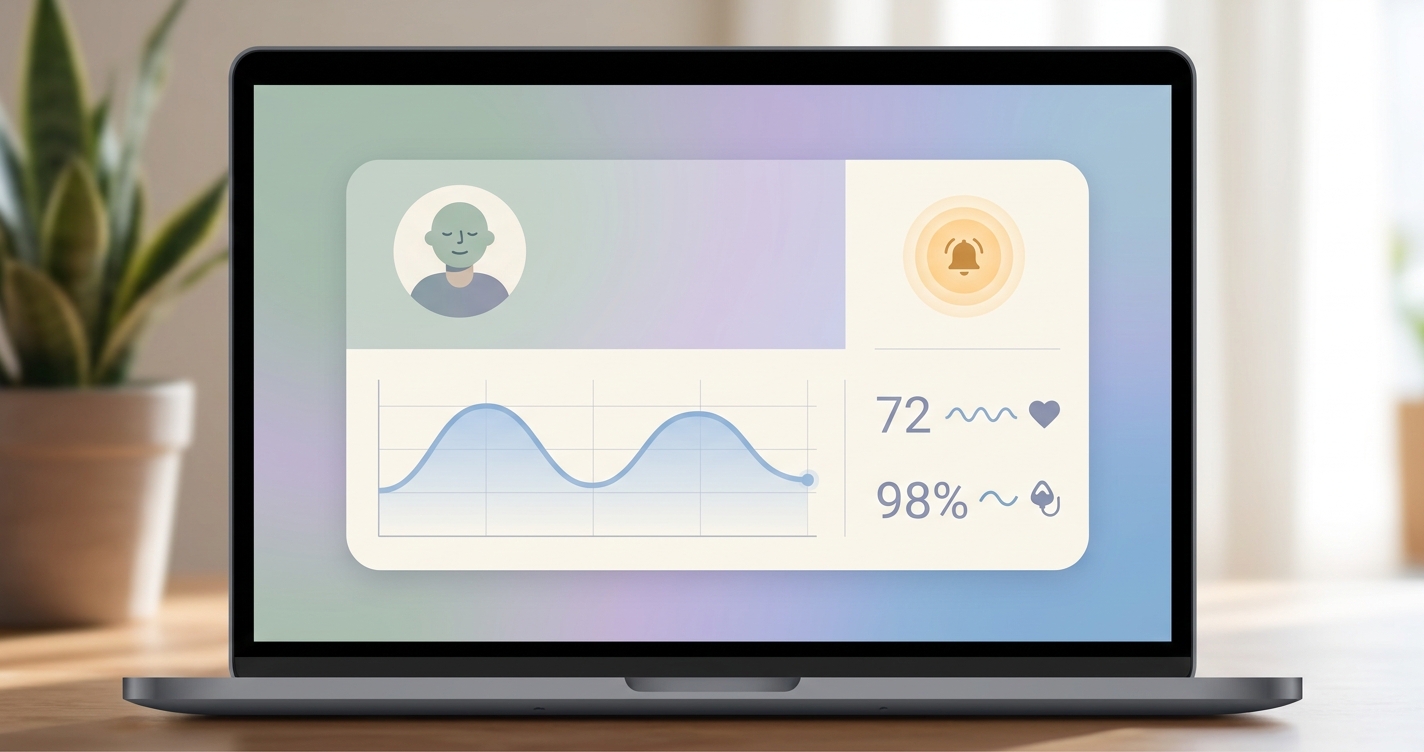
A patient settles into a video call, answers a few questions, and then says the words that change the tone of the visit: "I feel lightheaded." On a traditional telehealth platform, the provider has no instrument to confirm what is happening. They can see a face on a screen, hear a slightly slurred sentence, and watch the patient slump slightly in their chair, but they cannot measure the blood pressure that may be falling in real time. This gap is exactly where telehealth vital signs integration is moving from a product nicety to a clinical safety requirement, and it is the reason platform teams are now treating real-time monitoring and critical-event alerting as core architecture rather than a future roadmap item.
"Orthostatic hypotension is defined as a fall of at least 20 mmHg systolic or 10 mmHg diastolic within three minutes of standing, and a meaningful share of these episodes are asymptomatic until the patient is already in trouble." Findings consistent with the remote monitoring pilot reported by the Parkinson's telemedicine team in PMC (2022).
Why telehealth vital signs integration matters for sudden blood pressure changes
The fear behind the question is real and clinically grounded. A sudden drop in blood pressure during a consultation can signal orthostatic hypotension, a vasovagal episode, dehydration, a medication interaction, or the early phase of a more serious cardiovascular event. In an in-person clinic, a nurse can re-check a cuff reading within seconds. In a video visit, that feedback loop has historically not existed. The patient describes a symptom, the provider documents it, and the actual physiological signal goes unmeasured.
Telehealth vital signs integration closes that loop by turning the camera that is already running into a continuous sensor. Remote photoplethysmography, or rPPG, extracts the subtle color changes in facial skin caused by each cardiac cycle. From that signal a platform can derive heart rate, heart rate variability, respiration rate, and increasingly, blood pressure trends. The key word for critical-event detection is continuous. A single reading tells a provider where a patient is. A continuous stream tells them which direction the patient is heading, and direction is what matters when blood pressure is falling.
For platform engineers, the design problem is not only capturing a number. It is building a pipeline that can detect a trend, classify it against a clinical threshold, and surface an alert inside the provider interface fast enough to act on. That is a real-time systems problem layered on top of a signal-processing problem.
Comparison: how platforms detect a critical blood pressure event
The table below contrasts the common approaches a telehealth platform can take to catch a sudden blood pressure drop during a live visit.
| Approach | Latency to detection | Patient hardware | Continuous trend data | Integration burden | | --- | --- | --- | --- | --- | | Verbal symptom report only | Slow, depends on patient awareness | None | No | None | | Patient self-measures with home cuff mid-call | Moderate, interrupts visit | Cuff required | Spot readings only | Low | | Connected Bluetooth device feed | Fast for that one device | Device required, must be paired | Yes, if worn | Moderate | | Contactless rPPG via video stream | Near real time | None | Yes, throughout the visit | SDK or API integration | | Hybrid rPPG plus connected device | Near real time with confirmation | Optional device | Yes | Higher |
The pattern most platform teams converge on is contactless rPPG as the default capture layer, with optional connected devices for patients who already own them. The reason is friction. Every additional step between a worried patient and a measurement is a step where the measurement does not happen.
Key considerations when evaluating a capture approach:
- Time to first reliable reading, since a 30-second acquisition window is very different from a 5-second one during an acute event.
- Robustness to motion and lighting, because a lightheaded patient moves, slumps, and looks away from the camera.
- Confidence scoring, so the platform can suppress alerts built on low-quality signal rather than crying wolf.
- Threshold configurability, because a safe range for a frail elderly patient differs from that of a young athlete.
Industry applications for real-time critical-event alerting
Acute symptom triage during scheduled visits
The most direct application is the scenario in the title. A patient reports dizziness, and the platform is already streaming an rPPG-derived trend. If the system detects a falling heart rate variability pattern or an estimated blood pressure decline crossing a configured threshold, it can raise a visual flag in the provider's interface and prompt an escalation workflow, including an instruction for the patient to lie down before re-measuring.
Remote monitoring of high-risk populations
Patients with Parkinson's disease, autonomic dysfunction, or those on antihypertensive regimens are prone to orthostatic episodes. The 2022 PMC remote-monitoring pilot for Parkinson's patients found that a real-time home system identified numerous hypotensive episodes, including asymptomatic ones the patient never reported. Embedding similar logic in routine video visits extends that safety net without dedicated home hardware.
Post-acute and medication-titration follow-ups
When a clinician adjusts a blood pressure medication, the follow-up visit is precisely the moment a drop is most likely. A platform that captures vitals during that visit gives the provider objective evidence rather than relying on the patient's recall of home readings.
Current research and evidence
The evidence base for camera-derived vitals is maturing quickly but unevenly. Heart rate from rPPG is well established, while blood pressure estimation remains the harder frontier. A non-contact photoplethysmography mobile application study published in PMC reported a mean absolute error of 14.24 mmHg for systolic and 9.83 mmHg for diastolic pressure, which the authors framed as suitable for wellness monitoring and preliminary screening rather than definitive diagnosis. Deep-learning approaches reviewed in MDPI (2024), including work by Gyutae Hwang and colleagues, report lower errors in controlled experimental setups, though generalization across skin tones, lighting, and motion remains an open problem.
A practical reading of this literature matters for platform design. The OAE Publishing review on camera-based rPPG for blood pressure measurement frames the technology as strongest for trend detection and relative change, which aligns neatly with critical-event alerting. For catching a sudden drop, the clinically relevant signal is the magnitude and speed of change from a patient's own baseline, not an absolute calibrated number. A platform does not need to assert "your blood pressure is 88 over 55" to be useful. It needs to detect "blood pressure is falling fast relative to two minutes ago" and prompt human judgment.
Research on smartwatch heart rate variability for predicting standing hypotension, summarized in a ResearchGate report, reinforces that derived cardiovascular signals carry predictive value for these events even without a cuff. The engineering opportunity is combining HRV, respiration, and rPPG blood pressure trend into a single confidence-weighted alert rather than relying on any one estimate.
The Future of telehealth vital signs integration
Three shifts are likely over the next few years. First, alerting will move from absolute thresholds to personalized baselines, where the platform learns a patient's normal range across visits and flags deviation from that individual baseline. Second, signal fusion will become standard, blending rPPG, HRV, and respiration so that a critical-event alert rests on multiple converging signals and false alarms drop. Third, regulatory and reimbursement pathways will reward continuous capture, as remote physiologic monitoring codes increasingly recognize data collected during virtual encounters.
For platform companies, the strategic implication is that vitals capture is becoming a differentiator in safety, not just convenience. The platforms that can credibly say they will catch a falling blood pressure during a visit will win trust from clinicians and risk-averse health systems. The build-versus-integrate decision then comes down to whether a team wants to maintain its own signal-processing models or embed a dedicated SDK and focus engineering effort on workflow and alerting.
Frequently asked questions
Can a contactless system actually detect a sudden blood pressure drop during a video call?
It can detect the trend and direction reliably enough to trigger an alert, which is the clinically actionable part. Current rPPG blood pressure estimation is better suited to tracking change from a patient's baseline than to producing a single diagnostic-grade number, so most platforms use it for screening and critical-event flagging rather than diagnosis.
How fast can an rPPG-based alert reach the provider?
With a continuous capture pipeline, detection can happen in near real time during the visit, limited mainly by the acquisition window needed for a confident reading and the platform's alert-routing logic. The architecture goal is to surface a flag in the provider interface within seconds of a threshold crossing.
Does the patient need any special hardware?
No. Contactless rPPG uses the standard camera already running during the video visit, which removes the friction of pairing or owning a device. Platforms can still accept connected device feeds as optional confirmation for higher-risk patients.
How do platforms avoid false alarms?
Through confidence scoring, signal fusion across heart rate variability, respiration, and blood pressure trend, and personalized baselines. Alerts built on low-quality signal are suppressed so providers are not desensitized by noise.
Circadify is building toward this exact problem space, giving telehealth platforms a contactless rPPG capture layer and the real-time vitals pipeline needed to flag critical events like a sudden blood pressure drop during a live visit. Platform and engineering teams can review the SDK documentation and request a platform demo at circadify.com/custom-builds.